
Guest reading progress stays in this browser and is not synchronized to your account automatically. Use the learning panel to include browser marks and save them explicitly. Clearing site data removes browser marks.
Your learning notebook
Save courses and review situations deliberately. Load your account records on another device when you want to continue.
Bookmarks and review choices stay in this browser until you load and save an account. Answers and time spent reading are not recorded.
Saved courses
Saved situations to revisit
Find your marked situations by title or topic, then open the original question and explanation.
Your review choices will appear here when this learning view is ready. Use the account controls above to load account choices.
No situations are marked for review in this learning view.
No saved situation matches these filters. Clear the search or choose all topics.
Identification practice
Land access practice
Field decisions practice
Harvest care practice
Useful reading before this lesson
Start with these guides for background and preparation. You can open any guide at any time.
An Upland kit rehearsal: demonstrate what remains with each walker ↓
Read the Game Bird harvest ledger beside its actual licence ↓
Lay out the kit and assign the load ↓
An Upland kit rehearsal: demonstrate what remains with each walker
Rowan and Casey close the bags packed for a fictional short walk and demonstrate items during a stop. Ask what each person can reach, rather than whether the group list contains it somewhere.
Original tabletop and walking exercise, not a complete equipment list, certification or permission to hunt. Use an already lawful short practice route, without firearms or ammunition. The document module depends on the actual person and outing; a Game Bird harvest ledger is included only where applicable under current official requirements.
Turn an assigned item into a demonstrated arrangement
An item on the sheet is a question to test, not proof that the kit works.
- Name the holder
Separate each walker’s essentials, shared items and vehicle reserves.
- Show it from the closed bag
Find and explain the actual item with the layers you intend to wear.
- Walk and stop
Use the checked short loop to rehearse map, layer and ordinary packing stops.
- Record what changed
Write the failed demonstration, proposed change and what needs another test.
This table scrolls independently. Focus it and use the arrow keys to compare the four columns.
| Item or module | Who has it | What was demonstrated | What change requires another test |
|---|---|---|---|
| Personal map and light | Each walker. | Each reopens the return context and finds their carried light. | A different pocket, device, vest or return route changes the demonstration. |
| Applicable documents and ledger | The document holder. | At the table, the holder locates the actual required documents and explains the source still needing review. | Wet protection, a replacement document or a changed licence condition needs its own check. |
| Shared observation pouch | Casey is the named carrier for this example. | Both locate it and explain outward and return responsibility. | Casey leaves early: the shared arrangement must be revised before relying on it. |
| Game-care supplies and lunch | The packing sheet assigns separate containers and carriers. | Empty containers demonstrate the separate modules. | A changed container, leaking closure or new pocket arrangement needs another dry run. |
The ledger records demonstrations, not automatic completeness. A shared pouch does not cover another walker’s personal essentials.
Run a short test and leave a useful change record
- Use the actual bag, vest and layers. With clean hands, find map, light and documents, then food without opening game-care supplies. Do not fill a real harvest ledger during this fictional exercise.
- On the checked loop, read the carried map, put on the spare layer and restore the pockets. Notice hidden closures and swinging items. Adjust or end the rehearsal; do not extend the route to prove endurance.
- After returning, record the original arrangement, problem and proposed change. Name the layer, vest or access changes needing another test. Follow item-care instructions; retain the original observation instead of silently marking it resolved.
Change one responsibility, then explain the effect
The map worked beside the vehicle. What has not been demonstrated on the walk?
A successful display beside the vehicle does not show that the needed map and return context are carried or reopen without reception. Rowan’s vehicle-only reserve and personal walking module are different parts of the plan.
Pause the rehearsal and test the actual carried method in an appropriate known setting. Ask the companion to explain the return from that material. A failed test calls for a workable change and another short demonstration, not wandering farther to see whether reception returns.
The pouch is wet. Does a phone photograph settle the document problem?
A photograph may help describe what happened, but it does not establish that the actual document remains usable or that an image is an accepted substitute. Keep the clothing, storage failure and document question as separate entries.
Before relying on the arrangement, check the issuer’s current replacement or document instructions and protect the required material appropriately. Retest the pouch after the change. A spare empty pouch, private note or practice sheet does not by itself replace a required licence or applicable ledger.
Planning and current document references
Read the Game Bird harvest ledger beside its actual licence
At home, compare this teaching card with your actual documents before packing an ink pen and document protection.
Original exercise for ordinary licensed hunting. These placeholders are not an official ledger, licence or completed record. Check residency, actual conditions and exemptions separately.
Four links to rehearse before leaving
- Choose the category
Read Saskatchewan’s residency definitions and your actual licence.
- Match the documents
Check the ledger association, year and species conditions.
- Carry and record
Carry applicable documents; read the immediate ink-entry duty.
- Separate the tasks
Distinguish ledger, private tally and Hunter Harvest Survey.
Focus the table and use arrow keys to scroll.
| Check | Teaching placeholder | Question to resolve from the actual documents |
|---|---|---|
| Licence association | [Registered ledger ↔ valid licence] | Do the linked numbers match? |
| Licence year | [Actual licence year] | Does the ledger show that year? |
| Species | [Species printed on licence] | Which species does this cover? |
| Season limit | [Season limit on licence] | Is this the correct limit category? |
Work through three document changes
Game Bird harvest ledger · “I am Canadian.” Does only the Non-resident label matter?
Section 31(4.5)(b) addresses Table 1 licence applicants who are not Saskatchewan residents. This includes the other-Canadian-resident category, not only the provincial Non-resident category. The labels are not synonyms.
Section 31(6.2) requires association with a valid licence and its licence number, year, species and stated season limit. A blank ledger does not demonstrate registration.
Next action: Resolve missing or mismatched information with the issuer before relying on the documents.
Can a phone note now and ink at home complete the same task?
For a Game Bird licence holder with an associated ledger who takes Sharp-tailed Grouse or Hungarian Partridge, section 45(10) requires the taking date immediately in ink. The Guide uses Gray (Hungarian) Partridge. Section 45(11) also addresses possession without that ink date.
A later private note cannot demonstrate immediate entry. Rehearse finding ledger and pen with empty teaching materials; do not invent a date to repair a missed entry.
Next action: Read the actual instructions before departure; seek Ministry guidance for a missed or uncertain entry.
A new term or saved photo appears. Which checks remain?
A new short-term licence or blank ledger does not by itself demonstrate a reset of a species’ season limit. Keep earlier records when asking the Ministry how actual terms relate.
Section 31(8.1)’s digital-copy list names certain licences, not the harvest ledger. Do not assume a photograph, phone tally or SKHunter note replaces it. The licence page distinguishes licence reprints from replacement ledgers.
Next action: Confirm the applicable ledger and replacement process; keep photographs as separate backups.
Selected references checked: Selected government-hosted reference clauses and the previously verified 2026–27 Guide snapshot were checked. Original enactments govern interpretation; current notices and actual documents apply.
Carrying, ink dates and survey reporting are distinct
Registration and carriage checks are broader than the two-species ink-date rule. Daily, possession and season limits describe different periods or holdings. Hunter Harvest Survey is separate; a private tally replaces neither official task.
These selected clauses do not establish a mandatory WMZ field or settle a new term’s quota effect. Follow actual documents; confirm uncertain conditions with the Ministry.
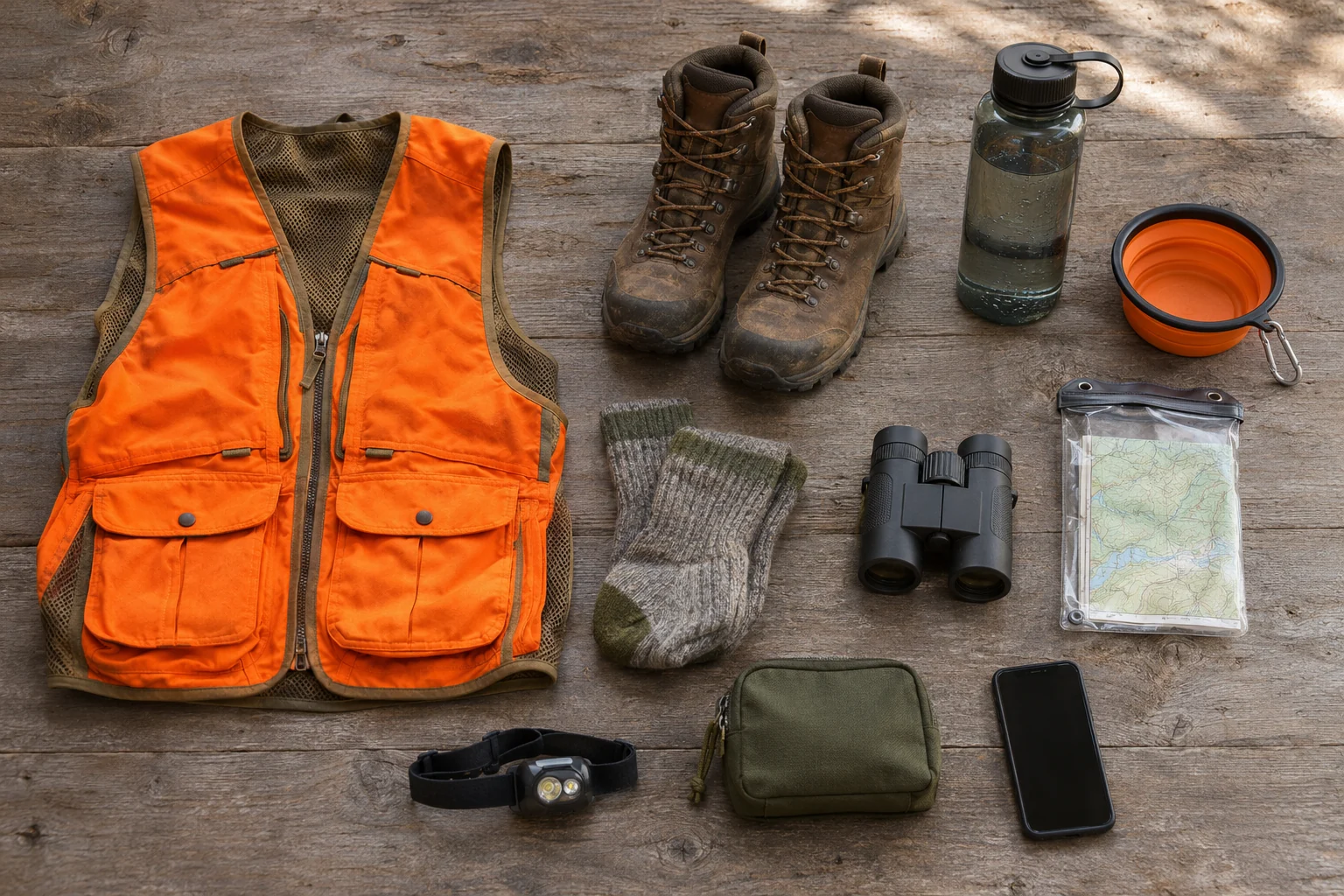
Original AI-generated teaching photograph of prepared supplies. The scene illustrates organisation, not a complete equipment list or a measurement of food temperature.
Image credit: SKHunter · original AI-generated teaching photographWhat you will learn
- Build a walking load that remains usable throughout the return.
- Check footwear, visibility, navigation and shared responsibilities before departure.
- Add a dog module only for the dog and handler actually joining the trip.
An original SKHunter learning guide
Test the walking kit before relying on it
A short loaded loop lets you find ordinary fit and access problems close to the vehicle.
Conceptual workflow · read the complete lesson below
- 01
Choose the test loop
Match prairie, field edge or woodland to the intended lesson. Identify return options and start the rehearsal without firearm or ammunition.
- 02
Fit the carried load
Use the intended footwear, socks and layers. Balance pockets, secure loose cords and keep water and a spare layer reachable.
- 03
Check independent modules
Open offline navigation, test light and check-in plans. Where a dog joins, the handler owns its water, control equipment and early return.
- 04
Practise stops and reset
Pause for water, clothing and map tasks. Correct discomfort, then inspect, dry, repair and replenish the kit for another short test.
Review your own plan
- Can you read the return route without reception?
- Which fit or pocket problem needs a second short test?
- If a dog joins, who can end its outing independently of the group?
Choose a short test route and divide the load
Begin with the terrain in the intended lesson: prairie, agricultural margin or woodland. Write the walk length you can sensibly rehearse, the return options, forecast and who will carry the equipment. A nearby loop with a checked return is a better test of an unfamiliar vest than a full day away from the vehicle. Start the practice walk without a firearm or ammunition.
Lay items on a table under three headings: always carried, trip-specific and vehicle reserve. Explain the purpose of each. The first group includes the navigation, communication, weather and delay items you need when the vehicle is no longer within easy reach. Shared tools get an owner, while personal essentials stay available to the person who may need them.
- Brief: terrain / party / planned loop / return options.
- Test the actual loaded vest or pack, not an empty display version.
- Leave room for changes in clothing and the planned return load.
Fit footwear and clothing during a real walk
Wear the socks, footwear and layers intended for the trip. On a short practice walk notice rubbing, slipping, restricted movement and pressure from straps. Stop to adjust rather than turning the test into an endurance challenge. Check care instructions and bring the route-appropriate dry reserve, weather protection and sun protection. A different sock or vest arrangement should be tried before the main outing.
Adjust pockets so dense items do not swing against knees or pull one side of the vest down. Secure loose cords and check access while wearing gloves. Select visibility clothing by the current rules and the needs of the actual party and terrain; this lesson does not carry forward an old season’s clothing rule. Compare what companions can see at ordinary walking distances during the rehearsal.
- Footwear: fit, fastening, sole condition and prior walking test.
- Clothing: movement, weather layer and accessible dry reserve.
- Load: balanced pockets, secured cords and reachable water.
Make navigation work without continuous reception
Prepare the local map, checked approach, return route and the useful surrounding roads. Open the saved material before leaving reception and ask a companion to describe the route back from it. Keep a backup suitable for the outing and your training. Record the observer’s position separately from any approximate wildlife observation.
A handheld device’s marker is one input; vegetation, terrain, battery and the underlying map still matter. In a practice session compare the display with known visible landmarks and explain what uncertainty you would record near a boundary. Test the light and communication method, protect electronics from weather and leave an agreed check-in plan with a trusted person.
- Open offline information and locate the return options.
- Show the party where backup navigation and light are carried.
- Record the check-in time and what happens if the plan changes.
Prepare a dog module around an individual plan
If a trained dog is joining, the handler prepares clean drinking water, a bowl, lead, identification, the planned control equipment and a field-care kit agreed with the dog’s veterinarian. Build conditioning progressively from the dog’s current ability. Allow for water and rest breaks rather than letting the pace of the whole party decide the dog’s workload.
Before departure check the dog’s readiness, the fit of any worn equipment and how the handler will return early. During breaks the handler checks comfort and visible paw problems; concerning changes mean ending work and seeking appropriate veterinary advice. Carry the emergency veterinary contact and transport plan. A first-aid pouch is not instruction for medication, wound closure or other veterinary procedures.
- Handler owns water, lead, control checks and the return decision.
- Plan a way to shorten the outing for the dog independently of the group’s ambition.
- Without a dog, remove this module and retain a realistic human recovery plan.
Rehearse the ordinary stops and compatibility checks
Pause during the practice walk to find water, put on the spare layer, read the map and reach the first-aid pouch. Check whether you can set the pack down without scattering equipment. Include personal medications, food, lighting, signalling and emergency shelter appropriate to the route and training. The test should reveal how the kit behaves when attention and hands are occupied.
Keep firearm handling within approved training and the manufacturer’s procedures. Before a hunting outing, verify the exact firearm, choke and ammunition combination against its instructions, plus current transport and storage guidance. Pack eye and hearing protection. Make a separate entry for any unresolved compatibility or service issue; do not improvise a fix during the outing.
- Practise stop / water / layer / map / return with the loaded kit.
- Confirm personal essentials remain with their owner.
- Resolve equipment condition and compatibility before departure.
End with a clean, repair and replenishment routine
Empty pockets and inspect what came home. Separate game-care items from food and personal supplies, remove field debris and follow care instructions for clothing, footwear and equipment. Dry items appropriately before storage. Check straps, closures and electronics, and mark faults so a damaged item cannot silently return to the next kit.
Write a three-line debrief: what was hard to reach, what caused discomfort, and what made the return easier. Replace used supplies, restore the original pocket plan and adjust only one or two items before the next short test. Where a dog joined, include the handler’s observations and any veterinary follow-up separately from the human equipment list.
- Empty and inspect every pocket.
- Clean and dry according to the product’s instructions.
- Repair, replenish and record the next short practice test.
Workshop: the vest is comfortable until the first stop
On a practice loop without firearms, your vest shifts to one side. A companion’s spare layer is in your pack, and the dog’s water is left in the vehicle.
Put it into practice
- Stop and rebalance the load before continuing the rehearsal.
- Return each person’s essential layer to their own accessible storage.
- Have the handler redesign the dog module with carried water and a shorter return option.
- Repeat a short walk with map, water and clothing stops.
- Choose a smaller first outing if the kit or conditioning remains unresolved.
Common mistakes to avoid
Trying new footwear on the longest outing
Use a short loaded practice walk to find fit problems before depending on the footwear away from the vehicle.
A group bag covers everyone’s essentials
Separate shared equipment from the items each person needs if temporarily apart.
The dog will keep up because it is eager
Plan around the individual dog’s conditioning and veterinary guidance, with water, breaks and an early return.
A practice walk reveals rubbing footwear and an unreachable spare layer. What should happen before the main outing?
- Walk farther to see whether the problems disappear.
- Add more shared equipment to stabilise the pack.
- Adjust and retest the fit and pocket layout on a short route.
Show the answer and explanation
Answer: C. Adjust and retest the fit and pocket layout on a short route.
The rehearsal is useful because it exposes ordinary problems close to help. Correct and retest them before committing to a longer walk.
Lay out the kit and assign the load
Use these starting modules to make a packing sheet for this outing. Lay the actual items out, choose your own quantities and name who carries each module out and back. Add or replace rows to suit the route and party.
This is a draft on this page, not a saved account checklist. Nothing here is sent or automatically saved by SKHunter. Your browser may restore form fields when you return. Avoid entering private contact details.
Choose a countable unit for each row, such as one bag or one decoy. Write the unit in the module name, then count the actual contents before entering the packed quantity. There is no automatic completeness check; the suggested modules are not a complete equipment list.
Use your browser’s Print menu for a paper copy. Check the print preview: the module, carrier and quantity columns should all be visible. Keep a copy of a useful draft before leaving this page.
See a fictional packing example
A worked organisation example, not a recommended load or quantity for your trip.
- A shared module is called “decoys (each)”. The party plans 12, counts 12 into the bag and writes 12 in both quantity columns.
- The carrier field says “Out: Alex / Back: Robin”. The group rehearses lifting and carrying the actual bag, including the return.
- A reserve layer assigned to the vehicle is reconsidered if someone needs it while walking. Move it to that person’s carried kit; a filled row does not decide where it belongs.
Terms on this page
Open a term for its meaning, a common mix-up and the existing guide. English terms and acronyms are retained.
retrieval / recovery
The separate plan for finding and bringing back a bird or animal described by an outing.
Common mix-up: A return plan for people does not describe every animal-retrieval task; keep recovery limits visible.
Current checks and official context
Begin with a short rehearsal
Test the actual carried load on a small route, without firearms or ammunition. Use the results to adjust fit, access and return options before planning a longer outing.
Use individual and current instructions
Check current Saskatchewan requirements and your equipment manuals. Plan a dog’s preparation with its veterinarian; this workshop provides organising exercises, not veterinary treatment or firearm-handling instruction.
Turn this lesson into your next outing
Review the date, species, starting template and linked day plan in an editable preparation draft. You choose what to add and save.
Prepare your own trip
Review a preparation draftContinue learning
Build a hunting day plan with a sensible fallbackTry a practical situation
The group disappears in coverOpening a draft does not create a saved checklist. A checked item records your own review, not permission or an open season.
Scenario practice
Put your field decisions into practice.
Try 24 situations across identification, access, field adjustments and harvest care. Compare your choice with the explanation, then revisit the relevant lesson.
Original sources
- AdventureSmart · Taking outdoor essentials and hiking preparation
- Government of Saskatchewan · Current Hunters Guide and updates
- RCMP · Storing, transporting and displaying firearms
- Browning · BPS owner’s manual (model-specific compatibility example)
- VCA Canada · Nutritional needs and hydration of performance dogs
Use this as a planning guide. Check current official requirements and site conditions before travelling.
Help improve this guide
Tell the editor about something on this public page that needs attention.