
Guest reading progress stays in this browser and is not synchronized to your account automatically. Use the learning panel to include browser marks and save them explicitly. Clearing site data removes browser marks.
Your learning notebook
Save courses and review situations deliberately. Load your account records on another device when you want to continue.
Bookmarks and review choices stay in this browser until you load and save an account. Answers and time spent reading are not recorded.
Saved courses
Saved situations to revisit
Find your marked situations by title or topic, then open the original question and explanation.
Your review choices will appear here when this learning view is ready. Use the account controls above to load account choices.
No situations are marked for review in this learning view.
No saved situation matches these filters. Clear the search or choose all topics.
Identification practice
Land access practice
Field decisions practice
Harvest care practice
Useful reading before this lesson
Start with these guides for background and preparation. You can open any guide at any time.
Reconcile three handover materials by item ID ↓
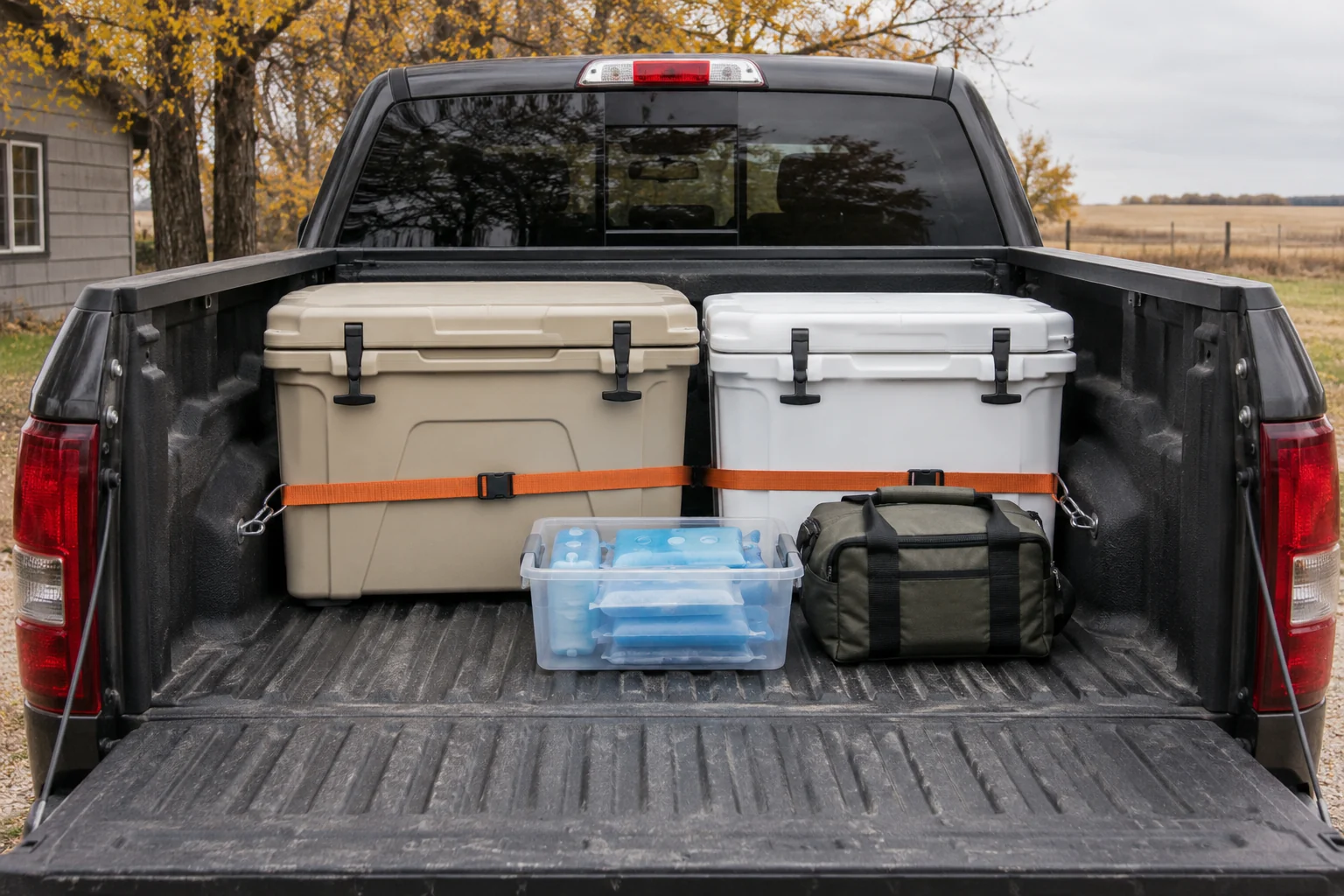
Original AI-generated teaching photograph of prepared supplies. The scene illustrates organisation, not a complete equipment list or a measurement of food temperature.
Image credit: SKHunter · original AI-generated teaching photographWhat you will learn
- Test cooling and transport capacity before a Big game outing.
- Keep each animal, package and sample connected to the right record.
- Hand over the load with an honest temperature and handling history.
An original SKHunter learning guide
Keep one animal connected from field to recipient
Build the receiving and cooling plan before the outing; record what actually happens during the return.
Conceptual workflow · read the complete lesson below
- 01
Confirm the recipient
Check acceptance, hours, reservation, capacity and the backup facility. Include recovery, loading and handoff in the timeline.
- 02
Separate and identify
Keep each animal’s containers and sample record connected to its own code alongside the required official marks and documents.
- 03
Document the cold chain
Use the trained help and cooling capacity matched to the load. Record measurements and interruptions rather than assuming outdoor air proves cooling.
- 04
Hand over the facts
Count containers together and report timing, condition and unresolved CWD status. Follow the current instructions for samples and waste separately.
Review your own plan
- Is the receiving facility confirmed for the revised arrival time?
- Can every container still be traced to one animal?
- Have you disclosed missing measurements or cooling interruptions?
Start with the receiving destination
Choose the receiving arrangement before the hunt: a confirmed processor, an appropriate cold room or a home setup whose capacity you have checked. Call to ask about hours, booking, carcass condition, documentation, CWD policy and what happens if you arrive late. Save an alternative that can actually receive the load. Write a route and realistic travel time from the intended area; include loading and recovery time, not just the drive shown by a navigation app.
- Who has agreed to receive the animal, and when?
- What load can the equipment, vehicle and people actually handle?
- Who supplies clean containers, cold capacity, lifting help and labels?
- What change in weather, access or time ends the original plan?
Arrange skilled help and separate work
Field dressing and any division of a large carcass require practical training and appropriate help. Rehearse the logistics with an empty load instead of learning those skills under time pressure. Prepare clean food-contact supplies separately from the dirty return container. Saskatchewan CWD guidance recommends dedicated field-dressing tools distinct from butchering tools and minimising contact with higher-risk tissues. Do not use this planning lesson as instructions for invasive cutting, head sampling or chemical prion decontamination; use the specific official procedure and qualified help.
Make cooling measurable
Prompt cooling must continue through transport and storage. Québec’s hunter food-safety guidance gives 0–4°C as the preferred transport and storage range. This is a cold-chain target, not a claim that a whole warm carcass instantly reaches it. Plan how a trained person will arrange the load to cool while protecting it from contamination; skinning and division decisions depend on the conditions and available facilities. A cold outside surface or winter air does not document the centre of a large load. Record actual measurements and location, not guesses.
- Keep the load away from engine or exhaust heat and direct sun.
- Use equipment suitable for the size and initial condition of the load.
- Keep edible parts protected and separate from dirty tools and waste.
- If cooling fails or is delayed, tell the receiver and seek food-safety advice; do not hide the gap.
Give one animal a continuous record
Assign a simple private animal code that sits beside, rather than replacing, required official tags and records. Use the same code on containers, the transport note and the sample record. Describe what each container holds. If two people harvest animals, give each animal its own set; do not combine trimmings into a shared bag while identities or testing status remain unresolved. At a handover, count containers together and have the receiver repeat the code back. Photograph only your own labels privately if useful, keeping licence numbers out of public posts.
Keep CWD questions separate from cooling
Check the current Saskatchewan requirements for the species, WMZ and licence. A submission needs the official CWD tracking number associated with the animal; your private code should point to that number, not replace it. Confirm current receiving arrangements before taking a head or sample. CFIA recommends testing before consumption and asks hunters using commercial processors to request individual processing. A negative result reduces uncertainty but is not a certificate that every food-safety hazard has been excluded. Do not eat or distribute known CWD-positive meat.
Hand over facts, then close the record
Give the receiver the animal identity, condition, times, measurements, any cooling interruption and CWD status. Ask how parts will remain separate and how a result will be matched later. Do not convert “sample submitted” into “negative” or “processor accepted” into “inspected and safe.” Saskatchewan provides specific carcass-waste and CWD-positive disposal instructions; confirm the permitted receiving site before transporting waste. Keep disposal and sample handling out of the kitchen workflow. Finally, record the receiving time and which containers changed hands.
Practice: a late arrival changes the destination
A processor who agreed to receive your animal will close before your revised arrival. Your backup has not confirmed capacity.
Put it into practice
- Pause further plans and contact the agreed receiver with the revised time and actual load.
- Check an appropriate alternative and its cooling capacity rather than driving between unconfirmed stops.
- Retain each animal’s tags, container code and sample link.
- Document the cooling history and any gap honestly.
- Hand over the count and status together; complete the disposal plan separately.
Common mistakes to avoid
Treating cold weather as a measurement
Air temperature does not document the temperature inside a large load or during a warm drive.
Combining animals to save bags
It becomes difficult to connect every package to the correct animal or CWD result.
Hiding a delay at the processor
The receiving decision needs the real handling history, including unknown periods.
Two animals have been sampled for CWD and neither result has arrived. How should their meat be organised?
- Mix trimmings now and separate the roasts only.
- Keep each animal identifiable and separate, linked to its own sample record.
- Label both animals negative because the samples were accepted.
Show the answer and explanation
Answer: B. Keep each animal identifiable and separate, linked to its own sample record.
Individual identity must survive the whole process. Sample acceptance is not a result, and mixing makes later decisions much harder.
Reconcile three handover materials by item ID
Compare a dispatch list, visible arrival labels and a receiving note. Find repeated identifiers, missing entries and unverified matches without using equal totals to fill the gaps.
Original fictional exercise: all codes, packages and documents are invented teaching materials, not an actual handover record. These IDs describe exercise items only.
Read the three sources
Dispatch list
EX-A-1EX-A-2EX-B-1
Labels visible on arrival
- Package P
EX-A-1 - Package Q
EX-A-2 - Package RID not legible
Receiving note
EX-A-1EX-A-1EX-B-1
The materials show 3 dispatch rows, 3 arrival packages and 3 receiving-note rows. Equal totals do not establish matching identities.
Compare each identifier
On a narrow screen, scroll the comparison table sideways. With keyboard focus, use the left and right arrows.
| Item ID | Occurrences on dispatch list | Legible arrival-label match | Occurrences in receiving note |
|---|---|---|---|
EX-A-1 | 1 | Package P | 2 |
EX-A-2 | 1 | Package Q | 0 |
EX-B-1 | 1 | No legible matching ID supplied | 1 |
Work through the discrepancies
EX-A-1 is repeated on the note
The dispatch list has one EX-A-1 entry and package P has that readable label. The receiving note repeats EX-A-1 in two rows. Those rows do not establish a second matching physical package.
A concrete follow-up: Ask which package each receiving row refers to. Keep the repeated identifier visible until the row-to-package relationship is verified.
EX-A-2 is absent from the note, not from the visible labels
EX-A-2 appears on the dispatch list and package Q, but not on the receiving note. Its absence from that note is a documentation gap, not evidence that Q is missing.
A concrete follow-up: Ask how Q should be represented on the receiving note. Verify the itemized record rather than changing a label just to make totals agree.
EX-B-1 has no verified arrival-label match
EX-B-1 appears on both lists, but no legible arrival label matches it. Package R remains unidentified; the supplied materials do not establish that R is EX-B-1.
A concrete follow-up: Request a check against the underlying identification material. Until new evidence resolves it, keep R unknown and the physical match for EX-B-1 unresolved.
This exercise checks information relationships only. It makes no finding about handling suitability, compliance or whether anything can be consumed.
Terms on this page
Open a term for its meaning, a common mix-up and the existing guide. English terms and acronyms are retained.
retrieval / recovery
The separate plan for finding and bringing back a bird or animal described by an outing.
Common mix-up: A return plan for people does not describe every animal-retrieval task; keep recovery limits visible.
Current checks and official context
Saskatchewan requirements stay attached to the trip
Consult current species, WMZ, licence, tagging, transport and CWD instructions before the outing. This lesson supplies a logistics method, not a new transport permission or a universal carcass-processing technique.
Plan an informed receiving decision
Wild game is perishable. Confirm capacity and discuss any abnormal condition or uncontrolled delay with the receiving professional or public-health service instead of relying on smell or a successful drop-off.
Turn this lesson into your next outing
Review the date, species, starting template and linked day plan in an editable preparation draft. You choose what to add and save.
Prepare your own trip
Review a preparation draftContinue learning
Plan CWD testing before your big-game tripTry a practical situation
Two coolers at the handoverOpening a draft does not create a saved checklist. A checked item records your own review, not permission or an open season.
Scenario practice
Put your field decisions into practice.
Try 24 situations across identification, access, field adjustments and harvest care. Compare your choice with the explanation, then revisit the relevant lesson.
Original sources
- Gouvernement du Québec · Wild game meat: information for hunters
- Government of Saskatchewan · CWD testing and sample identification
- Government of Saskatchewan · Hunting Best Practices for CWD
- Canadian Food Inspection Agency · CWD and hunter precautions
- Health Canada · Chronic wasting disease and food
Use this as a planning guide. Check current official requirements and site conditions before travelling.
Help improve this guide
Tell the editor about something on this public page that needs attention.