
Guest reading progress stays in this browser and is not synchronized to your account automatically. Use the learning panel to include browser marks and save them explicitly. Clearing site data removes browser marks.
Your learning notebook
Save courses and review situations deliberately. Load your account records on another device when you want to continue.
Bookmarks and review choices stay in this browser until you load and save an account. Answers and time spent reading are not recorded.
Saved courses
Saved situations to revisit
Find your marked situations by title or topic, then open the original question and explanation.
Your review choices will appear here when this learning view is ready. Use the account controls above to load account choices.
No situations are marked for review in this learning view.
No saved situation matches these filters. Clear the search or choose all topics.
Identification practice
Land access practice
Field decisions practice
Harvest care practice
Useful reading before this lesson
Start with these guides for background and preparation. You can open any guide at any time.
A first bird handover: count the birds and explain whose record goes with them ↓
A first bird handover: count the birds and explain whose record goes with them
At home, use empty labelled containers to rehearse a handover between two hunters. In this example Hunter B drives alone; Hunter A is not aboard the private vehicle. Start with a separate line for each person and species. Then ask whether a companion could explain the contents from the birds and records, without a phone call or a guess.
Original fictional exercise for a non-commercial handover of unpreserved migratory game birds in Canada. The quantities below are example inventory counts, not bag or possession limits. This is not an official label, a legal form or a compliance check. Read section 50, its applicable exceptions, the separate private-conveyance exception in section 56 and other requirements before a real handover; provincial Upland Birds need their own checks.
Four links to keep together
Teaching sequence, not an authorisation to transfer or possess birds.
- Person and species
Write who took each bird and what species it is.
- Physical identification
Check the applicable identification and preservation stage.
- Custody and label
Check the recipient and section 50 information before handover.
- Arrival count
Compare the received birds with each person’s original line.
This table scrolls independently. Focus it and use the arrow keys to compare the five columns.
| Person who took the birds | Species | Example count | Person carrying them | Record question |
|---|---|---|---|---|
| Hunter A | Mallard | 2 | Hunter B | Can Hunter B identify A’s two birds and the information accompanying them? |
| Hunter A | Canada Goose | 1 | Hunter B | Does the separate species line still connect to Hunter A? |
| Hunter B | Mallard | 1 | Hunter B | Can B’s own bird be distinguished from A’s two Mallard? |
The container total is four birds, but “four birds in Hunter B’s vehicle” loses the person-and-species breakdown. Reconcile all three original lines at the destination. The arithmetic does not establish anyone’s legal limit or entitlement.
Read the label requirement as five distinct information fields
Section 50 specifies information for the person who took the unpreserved bird, including the fields below. These placeholders are a reading aid only. Check the actual provision, exceptions, signatures and the package’s coverage; a private code or a photo alone does not replace a required label.
- Full name
- [Full name of the person who took the bird]
- Contact information
- [That person’s contact information]
- Date taken
- [Actual date the bird was taken]
- MGBH permit number
- [That person’s applicable permit number]
- Signature
- [Signature of the person who took the bird]
Run the empty-container exercise
- Place a separate example card beside each inventory line. Ask a companion to match the person, species and count before moving anything.
- Explain which identifying evidence stays with the actual birds, which information goes on a required label, and which notes are only your private inventory.
- At the imaginary destination, count again and compare each line. Stop and resolve a missing person, species or record instead of rewriting the list from memory.
Change one condition and explain the next step
A companion carries your birds home. Does temporary custody remove the label question?
Keep ownership and physical custody separate. Here Hunter B transports the unpreserved birds alone; Hunter A is not aboard. A short journey or an intention to return them does not by itself settle section 50’s requirements. Read the provision and applicable exceptions; do not treat “not a gift” as a complete answer.
Compare a different trip: section 56 exempts a transporter aboard a private conveyance from section 50 when the bird was hunted legally by an individual also aboard that conveyance. Check who is actually aboard. That exception does not remove section 52’s applicable physical identification and countability requirements, or settle separate gifting or other transfer arrangements. Read the actual provisions before a real handover.
One mixed container has only the driver’s name. What cannot be reconciled?
The name of the person driving does not explain who took every bird. In the example, two hunters’ Mallard and one separate Canada Goose line need to remain understandable; one container total conceals those links.
Return to the per-person and per-species inventory. Resolve which information must accompany each bird or the package under the applicable rules before transfer. Do not invent a taker or allocate birds afterwards merely to balance a total.
The birds were field-cleaned. Which questions still need separate answers?
Field cleaning alone does not demonstrate that a migratory game bird is fully preserved. Check the current preservation guidance and section 52’s applicable physical identification and countability requirements at this stage.
A clear label cannot replace identifying parts that must remain attached, and identifying parts do not replace a label required for a handover. Read both requirements before choosing a processing or transfer arrangement; do not rely on a photograph as the physical evidence.
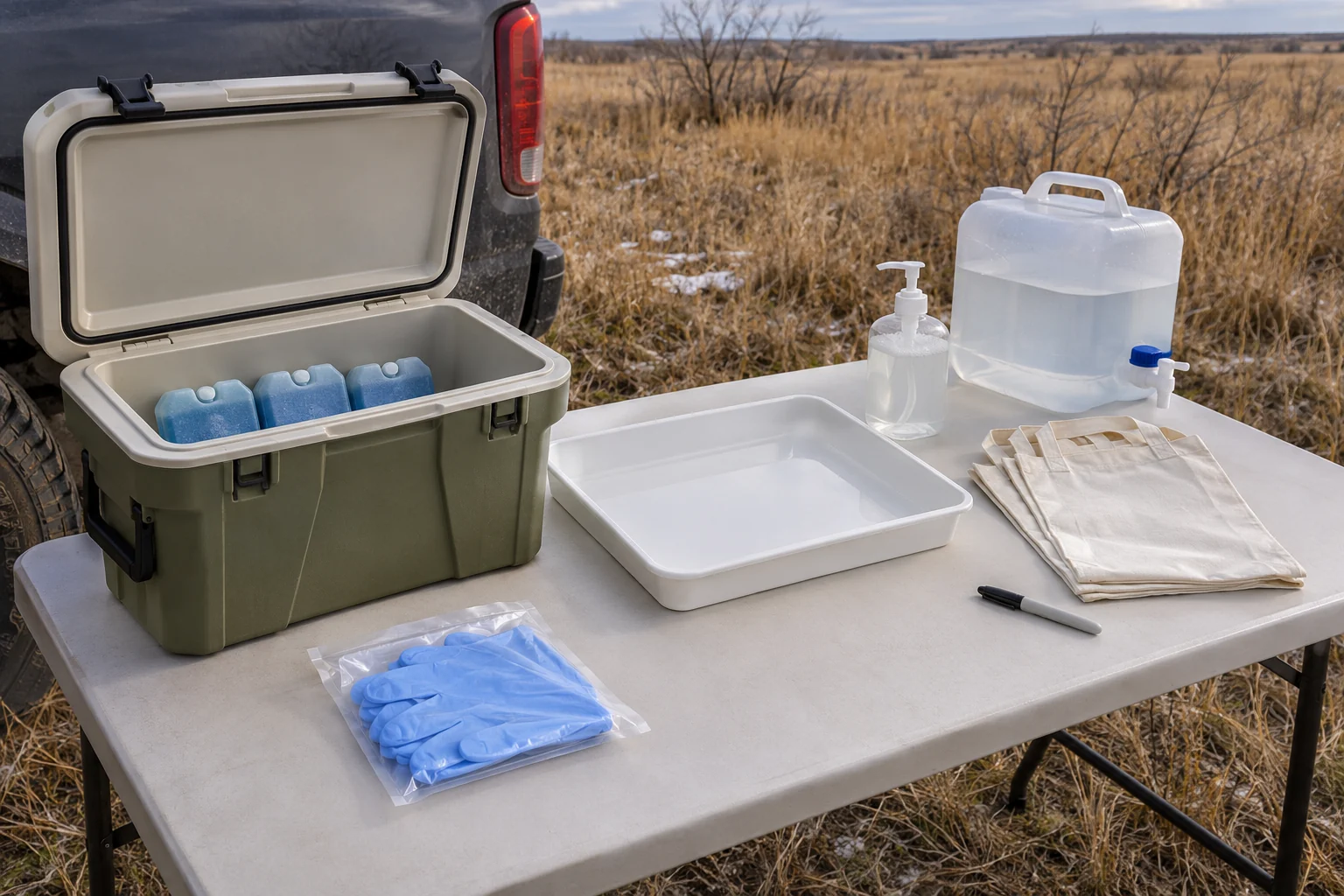
Original AI-generated teaching photograph of prepared supplies. The scene illustrates organisation, not a complete equipment list or a measurement of food temperature.
Image credit: SKHunter · original AI-generated teaching photographWhat you will learn
- Lay out a compact field-care station with a clear clean side.
- Keep each bird identifiable while arranging cooling and transport.
- Recognise when health concerns or missing cooling capacity require a change of plan.
An original SKHunter learning guide
Organise a clean-to-cold bird-care handoff
This diagram organises supplies and records around practical handling taught by a qualified person.
Conceptual workflow · read the complete lesson below
- 01
Set the clean station
Prepare hand hygiene, protected supplies, dedicated tools, labels, suitable cold capacity and a separate dirty-return container.
- 02
Pause for health and identity
Keep unusual birds out of the normal routine and follow current advice. Plan to retain the identification evidence required for the actual category.
- 03
Move to planned cooling
Use the checked cold equipment and protect clean food from raw birds and dirty liquids. Record the real handling and travel timeline.
- 04
Finish the handoff
Reconcile birds with personal records, place them in the planned facility and clean, dry and replenish the separate kit.
Review your own plan
- Who handles clean labels while others handle raw birds?
- Which identification evidence must remain attached for this stage?
- Does the actual cold capacity fit the planned load and return?
Rehearse the handover before the outing
Put the field-care kit beside your day bag at home and rehearse its use with empty containers. Give one person the record and label role, another the clean supplies role and identify who has the training to process birds. If hunting alone, decide where each item will sit so contaminated gloves never have to rummage through the whole bag. A small organised station is more useful than a large unstructured box.
- Clean kit: potable water, soap, disposable gloves, paper towels and a clean work surface.
- Care kit: suitable dedicated tools, protective containers, labels and a marker.
- Cooling kit: sufficient clean cold packs or ice, a suitable cooler and a thermometer.
- Dirty return kit: separate washable container for used tools and a waste bag.
Keep an unusual bird out of the normal workflow
The current PHAC guidance advises avoiding contact with wildlife suspected of avian influenza and reporting it to the appropriate wildlife authority. Keep people and dogs away from sick or found-dead wildlife. A familiar species or normal appearance is not a health certificate. If something looks abnormal, stop the ordinary processing routine and seek current instructions rather than opening the bird to diagnose it yourself. Record the circumstances from a safe position; do not turn an uncertain animal into a meal decision.
Create one direction of work
Choose a permitted, stable location where the work can be done without contact with soil, vehicle fuel or lunch supplies. Lay clean packaging on one side, tools and the working bird in the middle, and used supplies on the other. Take out what you need first. Keep a clean hand or a second person available for labels and lids. If both hands become contaminated, pause to change gloves and wash rather than touching every clean item. Learn the actual cleaning and dressing technique from a qualified instructor; this lesson organises the handling around that skill.
- Keep raw-bird handling away from eating and drinking.
- Do not place a phone, keys or bottle on the processing surface.
- Avoid moving feathers, blood or fluids into the clean kit.
- Protect clean supplies again before starting the next bird.
Retain identification through the correct stage
For unpreserved migratory game birds covered by section 52, an attached fully feathered wing or fully feathered head is required for species identification, and storage must allow birds to be counted. ECCC explains the separate stages of preservation; simple field cleaning is not complete preservation. Plan the instructor-led processing method around retaining that evidence. Keep birds and records distinguishable by person and species. Upland game-bird requirements are a separate provincial check; do not apply the migratory-bird rule to every bird by assumption.
Put cooling ahead of another stop
Cooling needs begin in the field. Do not leave birds in a sunny vehicle while continuing other activities. Decide how the load will reach your cooling equipment and who will check it; the cooler must have capacity for this actual load. Keep ready-to-eat food in another container and protect meat from leaking dirty water. Note the harvest, initial care, departure and arrival times on a simple trip card. These notes explain the handling history; they cannot prove safety after an uncontrolled delay. If capacity runs out, end the outing and obtain suitable cold storage.
Finish the job at the destination
Move the birds into the planned receiving arrangement before unpacking the rest of the vehicle. Reconcile the count and personal records, then separate dirty equipment from the kitchen. Follow current cleaning and disinfection guidance for the material and exposure involved. Saskatchewan advises against feeding dogs raw game-bird meat. Store the next-trip kit only after it is clean and dry; refill the items you used. Record one improvement, such as a leaking lid or labels that failed when damp, while it is still easy to remember.
Practice: the cooler is smaller than the day’s plan
At home, your mock packing exercise shows that supplies and lunch occupy most of the space intended for birds.
Put it into practice
- Remove food and clean supplies to separate containers.
- Check the capacity of the cooling arrangement with the actual containers and cold packs.
- Shorten the outing or arrange another verified cold-storage option.
- Write the limit into the trip plan and assign the person who will call the stop.
- On return, compare what happened with the original times and packing plan.
Common mistakes to avoid
Using gloves to touch everything
A glove that handled a bird can contaminate a phone or clean label roll. Arrange clean and dirty tasks before starting.
Removing every identifying part at the field station
Plan around the applicable species-evidence and preservation requirements before processing.
Calling a closed cooler a cooling plan
Capacity, cold source, load, time and destination all need an answer. A lid alone does not control temperature.
Your clean label roll is inside the bag, but both gloves have handled raw birds. What is the best next step?
- Rummage quickly before the gloves become dirtier.
- Pause, clean your hands and change gloves, or ask the clean-supplies person.
- Skip labels and identify all birds from memory.
Show the answer and explanation
Answer: B. Pause, clean your hands and change gloves, or ask the clean-supplies person.
Keep the clean supplies clean. A planned handover or a deliberate hygiene pause is better than contaminating the kit and losing the records.
Terms on this page
Open a term for its meaning, a common mix-up and the existing guide. English terms and acronyms are retained.
retrieval / recovery
The separate plan for finding and bringing back a bird or animal described by an outing.
Common mix-up: A return plan for people does not describe every animal-retrieval task; keep recovery limits visible.
Current checks and official context
Check the rules for the actual bird
Read the current federal preservation and species-identification guidance for migratory birds, and the provincial guidance for Upland Birds. Before transferring unpreserved migratory birds to another person, including temporary custody, check section 50’s labelling duties and exceptions. Its required hunter details include full name, contact information, harvest date, permit number and signature; a private code does not replace that label. Border crossing, gifting and commercial processing require their own checks.
Use current health guidance
Use PHAC and Saskatchewan wildlife-health instructions when handling concerns arise. The workflow below is an original planning exercise, not a diagnosis or a substitute for hands-on dressing instruction.
Turn this lesson into your next outing
Review the date, species, starting template and linked day plan in an editable preparation draft. You choose what to add and save.
Prepare your own trip
Review a preparation draftContinue learning
Waterfowl kit workshop: pack, test and reset a practical land-based loadTry a practical situation
A cold-feeling cooler needs evidenceOpening a draft does not create a saved checklist. A checked item records your own review, not permission or an open season.
Scenario practice
Put your field decisions into practice.
Try 24 situations across identification, access, field adjustments and harvest care. Compare your choice with the explanation, then revisit the relevant lesson.
Original sources
- Public Health Agency of Canada · Handling potentially infected animals
- Government of Saskatchewan · Avian Influenza in Wild Birds
- Government of Canada · Migratory Birds Regulations, 2022, sections 50 and 52
- Environment and Climate Change Canada · Migratory game bird questions, preservation and transport
- Gouvernement du Québec · Wild game meat: information for hunters
Use this as a planning guide. Check current official requirements and site conditions before travelling.
Help improve this guide
Tell the editor about something on this public page that needs attention.