
Guest reading progress stays in this browser and is not synchronized to your account automatically. Use the learning panel to include browser marks and save them explicitly. Clearing site data removes browser marks.
Your learning notebook
Save courses and review situations deliberately. Load your account records on another device when you want to continue.
Bookmarks and review choices stay in this browser until you load and save an account. Answers and time spent reading are not recorded.
Saved courses
Saved situations to revisit
Find your marked situations by title or topic, then open the original question and explanation.
Your review choices will appear here when this learning view is ready. Use the account controls above to load account choices.
No situations are marked for review in this learning view.
No saved situation matches these filters. Clear the search or choose all topics.
Identification practice
Land access practice
Field decisions practice
Harvest care practice
Useful reading before this lesson
Start with these guides for background and preparation. You can open any guide at any time.
Brief the outing · Ruffed Grouse
A woodland walk on a known route where dense cover may hide companions and the return junction.
An original planning summary to use with the full lesson. Check current law, permission, identification and local conditions separately; this card does not establish readiness or eligibility.
Open the briefing and field checks
Three tools and their jobs
- Offline map and a paper junction note: identify the return without depending on a phone signal.
- Headlamp with checked power: a return aid, not a reason to extend the plan.
- Weather layer and small first-aid kit: keep the short woodland trip self-contained.
Rehearse the complete visit
- Before leaving: Choose a route with recognisable junctions and an agreed turnaround point rather than an open-ended search.
- On arrival: Relocate the first return junction and check for closures, fallen timber and changed footing.
- Brief and organise: Stop together when cover blocks contact; keep an uncertain bird view separate from a confirmed identification.
- Return and review: Retrace the checked route and close the return check-in; note the junction or cover that needs a better plan.
Two avoidable mistakes
- A faint side trail can look more familiar than it is.
- Moving ahead to recover visual contact can separate the party further.
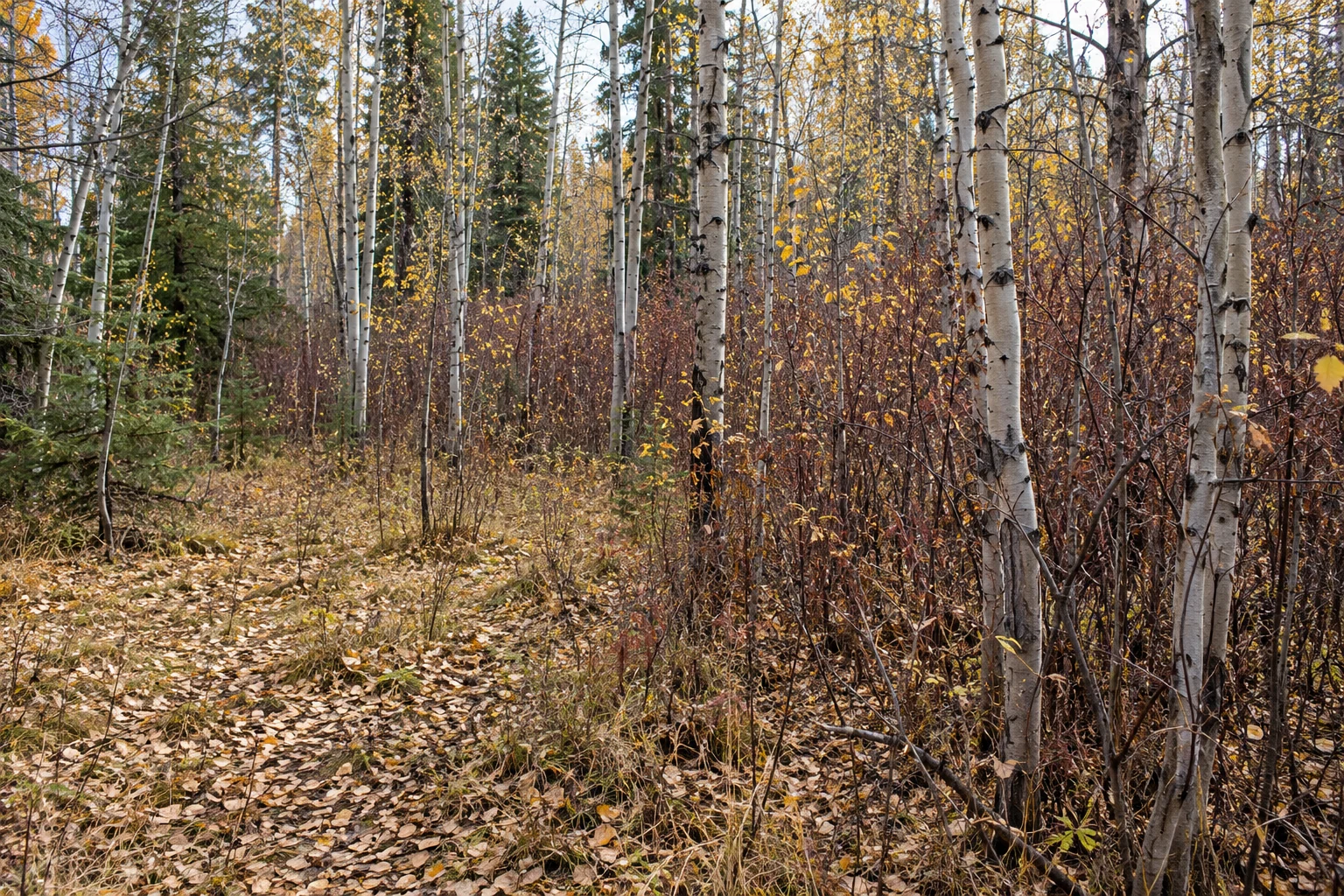
Illustrative habitat, not a real parcel, bird sighting or identification photograph.
Image credit: SKHunter · original AI-generated photo-style teaching sceneWhat you will learn
- Read young mixed woodland as a set of cover and food clues, without treating habitat or a sound as identification.
- Divide a woodland outing into short segments with visible contact, agreed stops and a route back.
- Choose dog or dog-free blocks that permit controlled movement, lawful recovery and prompt bird care.
An original SKHunter learning guide
Read forest structure before choosing a route
Ruffed Grouse use forest cover rather than the open prairie pattern of Sharp-tailed Grouse. In the northern part of their range, mixed-age aspen, birch and spruce can provide useful habitat. Young stems and understory can offer food and concealment beside more open patches. Compare the structure actually present: new deciduous growth, shrub cover, leaf litter and small openings. A label such as woodland on a map does not tell you how visible or passable it is today.
Look for a short block you can inspect without breaking contact or losing the way back. A patch of young growth beside older trees is a question to investigate, not proof of a bird location. Note the date, vegetation and what you could actually see. Ruffed Grouse can be grayish or reddish and other grouse may occur nearby; practise identification with a reliable reference, compare similar species such as Spruce Grouse and check the current rules for each. Never identify a hidden bird from habitat, apparent tameness or a burst of sound alone.
Use visible segments, not an imaginary straight line through trees
A neat line on the map can pass through stems that hide a person after only a few steps. Do not try to preserve a rigid abreast formation by sending people into opaque cover. Before starting, agree on one short segment, its clear stop point, the contact method and the return direction. The route must allow everyone to account for people, any dog and the background. A radio or tracking icon supports communication; it cannot confirm what is hidden behind vegetation.
Pause before a bend, dense understory, deadfall, drainage or boundary. If sight or reliable contact is lost, everyone stops hunting activity, confirms positions and arranges a controlled regroup at a known clear place. Do not improvise a hidden blocker at the other end of a thicket or split around opposite sides of a patch. If the next segment cannot be kept understandable and controlled, leave it for another plan. Shortening the walk is a practical decision, not an incomplete lesson.
Make recovery capacity part of choosing cover
A trained dog can help locate and recover birds, but woodland visibility makes handler control especially important. Assign one handler, check that permission includes the dog, and plan recall, rest, water and a clear way to stop. Local wind may help the handler assess the next block; swirling air beneath trees does not promise a flight direction or reliable scent conditions. If a dog disappears into cover or works beyond control, stop and restore control rather than trying to catch up while hunting.
Without a suitably controlled dog, choose shorter, more open patches where a person can mark and search a likely fall responsibly. Before proceeding, reject hazardous water, unstable deadfall, impenetrable growth and recovery routes outside consent. During recovery, keep other hunting paused, retain the exact last-seen mark and communicate before anyone moves. Prepare cooling and the current identification and transport requirements in advance. A recovered bird and a clear exit take priority over inspecting another stand.
Intermediate fieldcraftAfter permission · short checked woodland segments
For prepared, eligible participants walking permitted woodland. Use short visible segments with clear stopping places, rather than forcing the open-prairie walking pattern through trees. This lesson covers observation and coordination, not a driven hunt, firearms handling or dog training.
Read the habitat photograph as clues
- Young trees and understory: inspect how food and cover connect; an aspen patch alone does not identify or locate a bird.
- Natural opening: use visible ground as a possible checkpoint after checking footing, permission and the next short segment.
- Opaque shrubs: treat lost sight of a companion or dog as a reason to stop, not a cue to split around opposite sides.
Illustrative habitat, not a real parcel, bird sighting or identification photograph.
Choose a workable kit
| Item | Priority | What it does | Practical choice / alternative |
|---|---|---|---|
| Permission record and offline woodland map | Core kit | Keep the authorized entry, dog conditions, boundaries, excluded ground and return route available without reception. | Mark clear landmarks on a paper map; a trail symbol does not establish public access or current passability. |
| Binoculars and reliable grouse reference | Core kit | Study actual birds from an authorized position and compare Ruffed Grouse with similar species before the outing. | Leave uncertain birds alone; cover type, colour alone, a sound or calm behaviour does not identify an individual. |
| Compass, charged navigation and familiar backup | Core kit | Relate each short segment to the entry and a known return direction beneath tree cover. | Practise with the tools before travelling and use a marked paper route; shorten the visit if navigation is uncertain. |
| Visible clothing and a stop/contact agreement | Core kit | Help the group keep track of people and pause before a bend, opaque stems or a change of route. | Check current clothing requirements separately. Visibility aids and radios support observation rather than proving a hidden person’s position. |
| Familiar boots, layers and personal protection | Core kit | Handle wet leaves, uneven ground, branches, exposure and eye/ear protection with equipment already familiar to you. | Choose easier segments and consult qualified instruction for equipment or handling questions before the field visit. |
| Water, food, first aid and return-time margin | Core kit | Reserve capacity for the return, recovery, a minor injury or a delay instead of filling the day with outward walking. | Leave a route and overdue plan with a trusted contact; select suitable additional communication for remote travel. |
| Notebook and removable last-seen marker | Core kit | Record cover, wind, stopping places and the precise last-seen point against a fixed landmark. | Use a pencil and sketch if necessary; collect temporary marks and do not cut vegetation to make a route. |
| Trained-dog control and care equipment | Optional | For an authorized dog, prepare reliable control, lead, identification, water, rest and a handler’s care plan. | A locator supplements control. Without a suitable dog, choose open short blocks with a workable human search and recovery plan. |
| Recovery, hygiene and cooling supplies | Core kit | Care for recovered birds promptly and retain current required identification, possession or transport evidence. | Shorten or end the outing if timely cooling and lawful recovery cannot be maintained; do not pack warm birds tightly together. |
Use clear checkpoints in a small woodland block
Original teaching sketch · not to scale. Circles represent people, not firing positions. No safe shooting sector, fixed distance, bird location or entry permission is established.
- Young trees and understory are habitat clues to inspect, not proof of Ruffed Grouse presence or identity.
- A and B are both paused at one clear checkpoint. Their circle symbols do not define spacing or safe firing positions.
- Discuss the next short section from a clear checkpoint. Continue only while contact and the checked route remain workable; return on a verified route if they do not.
- The marked boundary ends this example’s permission. Cover continuing beyond it does not authorize entry or recovery there.
- Young woodland, shrub food and openings are habitat clues, not a map of actual birds or a complete identification guide.
- Use short checked segments and visible clear stops; a winding line does not prove it can be followed safely through real understory.
- If stems hide a person or dog, everyone pauses and restores contact before any restart; no hidden blocker is part of this lesson.
- Verify the entire route and potential recovery ground against consent, current game-bird closures and local conditions.
Nine stages of a controlled walking outing
Recheck the woodland access
Start at the agreed entrance with today’s conditions and permission.
- Confirm walking, people, any dog, parking and recovery access with the responsible person.
- Locate boundaries, other users, work areas, closures and hazards before choosing the first block.
- Check current species, residency, licence, area, date and required records; woodland habitat does not establish an open season.
Compare a small cover transition
Read young stems, understory and nearby open ground as clues.
- Observe from a checked position without using a firearm optic as binoculars.
- Separate a bird actually seen from possible food, cover and an old report.
- Choose one short question to investigate, such as whether the young growth has a visible passable edge.
Name the next visible stop
Divide the walk into a segment with a clear end and return direction.
- Use a distinctive clearing, edge or other fixed landmark everyone can recognize.
- Check that contact can be maintained throughout, not only at the start and finish.
- Reject shortcuts through opaque stems, unstable deadfall, uncertain water or unconfirmed access.
Agree how everyone pauses
Set a contact method and stop rule before entering cover.
- Anyone may call the stop; everyone pauses when a person or dog becomes uncertain.
- Do not force an abreast formation through invisible woodland or place an unseen person ahead.
- Agree a controlled regroup at a known clear point and communicate before changing direction.
Choose the dog or dog-free block
Match the cover to actual control and recovery capacity.
- With a trained dog, assign one handler and plan recall, water, rest and the permitted working area.
- Use local wind as information; trees can disturb it and no bird departure direction is guaranteed.
- Without a suitable dog, prefer shorter open cover and decline likely falls that cannot be searched responsibly.
Inspect one segment deliberately
Pause to observe while keeping the route and companions understandable.
- Watch current ground cover and food clues rather than counting kilometres walked.
- Stop before a bend, thick stems, a fence or a drainage interrupts visibility or contact.
- Do not split around the thicket or hurry toward a sound; select another segment if reliable coordination cannot continue.
Confirm the individual and situation
Make identification and a clear complete situation prerequisites to any hunting decision.
- Compare visible features with your practiced reference; Ruffed Grouse and Spruce Grouse are distinct species with separately checked conditions.
- Pass uncertain, protected, obscured or otherwise unsuitable birds; a habitat label is not identification.
- Keep people, dog, background, access and recoverability accounted for, along with your applicable remaining allowance.
Pause for a marked recovery
Keep the last-seen point fixed and coordinate a lawful search.
- Mark the last-seen point against a tree or other stable landmark before leaving the observation position.
- Keep other hunting paused, assign clear roles and communicate before a person or dog moves into cover.
- Do not cross a consent boundary or enter hazardous water or deadfall; seek the required permission or appropriate help.
Care, record and leave on time
Finish prompt bird care and return while the agreed margin remains.
- Use hygienic handling and cooling and follow current identification, recording, possession and transport instructions.
- Record the cover inspected, actual sightings, uncertain identity and the point where visibility limited the plan.
- Collect litter and markers, check dog and people, follow agreed gate conditions and notify the return contact.
Diagnose the walk before adding distance
Pause → check the cause → change one thing
Loss of sight: stop first, then agree how to regroup
The panels describe an interrupted outing. Do not keep walking to guess where a companion will emerge. Restore contact and agree a checked route to a clear meeting point before anyone relocates.
Contact lost · both stop
Trees now hide A from B. Both stop where they are, pause the activity and locate each other and any dog through the agreed communication method. Nobody advances to flush cover or circle the hidden person.
Contact restored · pause together
Only after contact and a suitable route are confirmed, regroup at the agreed clear checkpoint with the activity still paused. Both people remain stopped while they decide whether a shorter route is workable or the outing should end.
Orange circles mean both people have stopped. The next panel is a later state after an agreed regrouping, not a direction to walk blindly through the trees. No movement or firing arrows connect the people.
Keep routes short enough to maintain workable contact. Dense cover, terrain, other people, dogs and permission can require a different route or an early return. Original teaching sketch · not to scale. Circles represent people, not firing positions. No safe shooting sector, fixed distance, bird location or entry permission is established.
| What you observe | Check first | Make one change |
|---|---|---|
| The mapped forest looks promising, but the ground is mature and open. | Did you confirm understory and young growth, or rely only on the woodland map colour? | Observe another authorized cover transition and record the actual structure without claiming birds must be there. |
| A companion vanishes after a few steps. | Can all positions and a checked clear regroup point be confirmed? | Pause everyone and restore contact; shorten or reject the segment rather than stretching a line through trees. |
| You hear a departure but see no identifying features. | Is this an identified bird, or only an uncertain sound and direction? | Leave the opportunity alone and record the uncertainty; do not follow the sound as a target or guaranteed location. |
| The dog becomes invisible, difficult to recall or tired. | Can the handler restore actual control and suitable rest? | Pause, secure and assess the dog; choose more open cover, shorten the outing or finish if control remains unsuitable. |
| The last-seen location is tangled, hazardous or beyond permission. | Is access lawful and a realistic safe search possible with the people and dog available? | Keep hunting paused, preserve the mark and arrange appropriate permission or assistance without forcing entry. |
Open the field reference card
- Recheck the woodland access
- Compare a small cover transition
- Name the next visible stop
- Agree how everyone pauses
- Choose the dog or dog-free block
- Inspect one segment deliberately
- Confirm the individual and situation
- Pause for a marked recovery
- Care, record and leave on time
Before the next outing
Keep a woodland record small and precise: the cover transition checked, the last clear stopping place, what was actually identified and why a segment was rejected. Better visibility and a reliable return are useful outcomes even when no bird is taken.
Worked example: the next opening is hidden by young stems
Two participants are walking an authorized woodland edge. The map suggests a small opening beyond a dense strip, but one person can no longer see the other and the dog’s position is uncertain. A bird is heard leaving. This is an original coordination exercise, not a real parcel.
Put it into practice
- Call the agreed stop and keep hunting paused; a sound in the thicket is not a confirmed bird or a reason to advance.
- Establish the people’s known positions and let the handler restore dog control before planning a regroup.
- Regroup through an agreed checked route at the last clear point; do not send a person around the far side as a blocker.
- Reject the opaque shortcut and choose a shorter visible segment or return, recording the visibility problem separately from the bird observation.
Turn a sighting into a useful note
A 36-second photographic motion explainer with gentle camera movement, four clear chapters and large on-screen words. Silent; optional captions and a transcript are available.
Choose a section or use the player controls. A text transcript is available below.
Read the video transcript
- 0:00
Describe what you actually saw — Record shape, markings and behaviour before assigning a species name.
- 0:09
Record the observation context — Add the date, viewpoint, light and approximate distance.
- 0:18
Keep uncertainty visible — A single track or a brief glimpse may remain unidentified.
- 0:27
Revisit without assuming — One sighting is not a population estimate or a promise for next time.
Common mistakes to avoid
Reading every forest patch as the same habitat
Compare young growth, older stems, food clues and current visibility. A map colour or an old sighting is not evidence of birds using this patch today.
Keeping an abreast line after people disappear
A geometric formation does not overcome dense understory. Pause at a clear stop point and select a segment that preserves known positions.
Letting a dog or departing sound dictate the route
Restore control and confirm identity and access. Neither a tracking icon nor a sound makes a hidden location suitable for a hunting decision.
A companion and the dog are no longer visible beyond young stems. You hear a bird depart. What is the appropriate next step?
- Follow the sound and assume the others will meet you at the next opening.
- Pause all hunting activity, confirm positions and dog control, then regroup at a checked clear point.
- Send the companion around the far side to cover the exit.
Show the answer and explanation
Answer: B. Pause all hunting activity, confirm positions and dog control, then regroup at a checked clear point.
Dense cover makes guessed positions unreliable. Stop, restore contact and control, and choose a visible route before restarting; a sound does not establish identity or a safe opportunity.
Upland observations: checked margin versus hidden cover
A fictional group records what it can actually inspect. These are general observation notes, not claims about the behaviour of Sharp-tailed Grouse, Gray Partridge, Ruffed Grouse or Ring-necked Pheasant.
Fictional teaching example, not a parcel sighting or current conditions report. Example times are not hunting-hour guidance.
Scroll across the table to compare each observation with its interpretation and next check.
| Time | Direct observation | Count and scope | Interpretation / uncertainty | Next check |
|---|---|---|---|---|
| A visible margin is watched for five minutes; no birds are observed. | 0Zero in this sample Zero birds observed in the checked view. | This is a zero for that view and interval, not proof about nearby cover. | Keep the viewed margin and observation interval with the zero. | |
| Dense cover beside the margin is neither visible through nor searched. | Unknown Cover not inspected; count unknown. | The group has no numerical observation for this cover. It cannot be entered as zero. | Keep it unobserved; choose only a short segment with a checked return and workable visibility. | |
| Two birds are briefly visible, but the details do not confirm species. | 2Observed count Two visible birds; species unconfirmed. | The count and uncertain identification are different fields. Habitat or the course title cannot supply the missing identity. | Record the last-seen landmark and uncertainty without filling in a species guess. |
Counts belong to the stated view or sample. Repeated views may include the same animals; these rows are not summed into a unique population total.
A concrete next action
Keep the route question small: what can the group observe and return from today? Do not extend a walk just to turn unknown cover into a more reassuring record.
Pause and reflect
Which rows can carry a number, and which must stay unknown?
Read the reasoning
The first row carries zero for a checked view; the last carries two visible birds with uncertain species. The uninspected cover has an unknown count. These entries are not a population estimate.
Terms on this page
Open a term for its meaning, a common mix-up and the existing guide. English terms and acronyms are retained.
sample coverage
The view or ground, and observation interval, that were actually checked for a particular record.
Common mix-up: Hidden or uninspected ground lies outside that checked sample, even when it is nearby.
unknown count
A record for which no reliable numerical animal count was obtained.
Common mix-up: Unknown is not zero. Uncertain species identity does not by itself erase a number actually seen.
retrieval / recovery
The separate plan for finding and bringing back a bird or animal described by an outing.
Common mix-up: A return plan for people does not describe every animal-retrieval task; keep recovery limits visible.
Current checks and official context
Use the upland species row and your own licence category
Ruffed Grouse is an upland game bird. Open the current provincial Ruffed Grouse row for your residency category, Game Bird District or Management Unit, and intended date. Check Game Bird Licence, Wildlife Habitat Certificate, education and youth conditions. A woodland that looks suitable is not evidence that a season is open.
Read its own daily and possession limits and any applicable recording, survey or transport requirements. Do not copy the Sharp-tailed Grouse or Gray Partridge ledger conditions or another province’s combined-grouse limits. If the outing also targets migratory birds, check the additional federal requirements for that activity. A glimpse, sound or forest type is not enough to identify a legal bird; check Ruffed Grouse, similar grouse and any protected species separately.
Check the whole walking route, not just the starting point
Confirm the exact parcel, authorized people, activity, dates, dog conditions and approach with the owner, occupant or responsible manager. Grass strips, fences and hedgerows may border a different parcel. Stop before the boundary; a bird or a dog crossing it does not extend your permission.
Hunters Extras includes named game-bird closures, including specified water areas and applicable 500 m restrictions. An upland walk on dry land can still enter a restricted area. Check the current named-area list, dates, feeding-station or lure-crop conditions, local closures and posted instructions; there is no blanket 500 m rule for every pond.
Check equipment, recovery and transport requirements separately
Confirm current lawful equipment and ammunition conditions for the species and exact property. Do not copy the waterfowl rules into an upland-only trip, or assume lead shot is allowed on every site. Keep people, dogs, livestock and the background accounted for; uncertain identification, low or obscured flight, lost contact or an unrecoverable fall are reasons to pass and reassess.
Prepare prompt lawful recovery, suitable cooling and clean handling before starting. Follow current provincial identification, possession, transfer and transport instructions; check destination and border requirements separately. Consult current avian-influenza advice, avoid sick or dead birds found in the field and prevent dogs from contacting them. The sketches illustrate coordination, not certified safe shooting positions.
Pocket lesson card
Public teaching summary for review and offline reading. It contains no actual trip records, permissions, parcel conditions or coordinates. Use the full lesson and current official guidance for your own plan.
Save the HTML for offline text. Use your browser’s Print menu to print the opened card; online links require a connection.
Read the pocket card
Ruffed Grouse · field preparation
Before leaving
- Mark the woodland entry, return direction and a small cover transition.
- Check navigation and contact methods before trees limit the view.
At the location
- Name the next clear stop before bends or opaque stems.
- Reject uncertain shortcuts and keep the visible route question small.
Return
- Close the return check-in and collect equipment and waste.
- Use the checked return; shorten the visit if contact deteriorates.
Review
- Choose one missing piece of evidence to check next time.
- Retain rejected segments and why view or return remained uncertain.
A fictional observation example
Fictional example: a visible margin is checked with no birds seen. The blocked area beside it remains unobserved; the zero does not extend into that cover.
Full reviewed lesson · onlineSource lesson editorial review: 2026-11-01
Turn this lesson into your next outing
Review the date, species, starting template and linked day plan in an editable preparation draft. You choose what to add and save.
Prepare your own trip
Review a preparation draftContinue learning
Game birds after the harvest: clean handling, cooling and the journey homeTry a practical situation
The group disappears in coverOpening a draft does not create a saved checklist. A checked item records your own review, not permission or an open season.
Scenario practice
Put your field decisions into practice.
Try 24 situations across identification, access, field adjustments and harvest care. Compare your choice with the explanation, then revisit the relevant lesson.
Original sources
- Government of Saskatchewan · current Hunters Guide and updates
- Government of Saskatchewan · hunting licences and eligibility
- Government of Saskatchewan · Hunters Extras and upland definitions
- Government of Saskatchewan · avian influenza in wild birds
- Cornell Lab of Ornithology · Ruffed Grouse life history
- Cornell Lab of Ornithology · Ruffed Grouse identification and similar species
- Texas Parks and Wildlife · hunter education: hunting with dogs
- Texas Parks and Wildlife · hunter education: field care
Use this as a planning guide. Check current official requirements and site conditions before travelling.
Help improve this guide
Tell the editor about something on this public page that needs attention.