
Guest reading progress stays in this browser and is not synchronized to your account automatically. Use the learning panel to include browser marks and save them explicitly. Clearing site data removes browser marks.
Your learning notebook
Save courses and review situations deliberately. Load your account records on another device when you want to continue.
Bookmarks and review choices stay in this browser until you load and save an account. Answers and time spent reading are not recorded.
Saved courses
Saved situations to revisit
Find your marked situations by title or topic, then open the original question and explanation.
Your review choices will appear here when this learning view is ready. Use the account controls above to load account choices.
No situations are marked for review in this learning view.
No saved situation matches these filters. Clear the search or choose all topics.
Identification practice
Land access practice
Field decisions practice
Harvest care practice
Rehearse the first decisions before putting the bag in the vehicle ↓
Check the whole clothing arrangement, not only the vest ↓
Rehearse the first decisions before putting the bag in the vehicle
Close your packed bag and work through one short observation-only visit with a companion. Show the actual map, route record and supplies you would use. The useful result is finding a missing connection while you can still fix it at home.
Original fictional rehearsal. Plan A is a checked observation walk from Parking A along Approach A; Plan B is a different parcel with a possible shorter walk. The B column describes unresolved checks, not an approved alternative. These examples set no hunting hours, weather limits or permission for a real visit.
The table scrolls independently. Focus it and use the arrow keys to compare both columns.
| Check | Plan A: rehearsed walk | Plan B: separate candidate |
|---|---|---|
| People, date and activity | The example’s dated access record covers these people and this observation walk. | A contact has not answered the new request. A’s permission does not cover B. |
| Parking and the whole approach | Parking A and the return along Approach A have been checked. | The suggested parking place and any crossing of neighbouring land still need checking. |
| Time reserved for the complete return | The outward trip, turnaround, packing and return are included in A’s plan. | Recalculate B’s own travel and return; a shorter walk alone does not prove a shorter day. |
| Map usable on the actual device | The companion can reopen A’s saved area and explain the route back. | A shared web link is all that is available; the needed area has not been tested offline. |
| Responsible contact’s copy | The contact has A’s understood route and agreed check-in arrangement. | B is absent from that copy; a proposed change still needs the agreed communication process. |
Show three things at home
- From the closed bag, find the map and essential route record. Explain the parking place, outward path and return without relying on an unexplained saved marker.
- Test the map and documents without a connection at home. Reopen the needed area and check the context for the return; choose backups you know how to use if the test fails.
- Ask a companion to repeat the destination, turnaround decision and agreed check-in process in their own words. Compare their explanation with the copy intended for your responsible contact.
Change one part of the example
The agreed entrance is blocked. Why is Plan B still a candidate?
Pause the intended approach. B’s unanswered access request and unchecked parking remain unresolved even if its track looks close on the map. Do not replace the agreed approach with another route by assumption.
Name the missing checks before choosing an action: clarify with the appropriate person, use an independently completed alternative that still fits, or return. Record the changed entrance for the next plan.
The map will not reopen offline at home. What needs fixing?
Treat the rehearsal as useful evidence: the planned navigation method has not passed this particular test. Identify whether the required area, route context or document was unavailable, then prepare and test it again.
A familiar-looking screenshot is not a demonstration of the whole return. Practise a suitable backup within your skills, or choose a less demanding outing with a workable navigation arrangement.
You sent a message about a later return. Is the revised plan understood?
Sending a message does not establish that the contact received or understood the new destination or return arrangement. Use the communication process you agreed before departure and confirm the required change through it.
If the revision cannot be established, work within the original arrangement by shortening or ending the visit. Afterwards, compare planned and actual events with your companion and responsible contact rather than silently replacing the old record.
Check the whole clothing arrangement, not only the vest
Lay out each person’s torso outer garment and headwear before a Big Game outing. Compare the actual items with the references; repeat when people, activity or season change. Warmth and legal visibility need separate checks.
An original reading rehearsal for ordinary Big Game arrangements. It does not certify a product, determine an exception or govern all bird hunting. The table asks questions rather than approving your clothing.
Four checks before the clothing goes in the bag
- Name each person’s role
Include the hunter, companion and guide in the review.
- Separate torso and head
Read the requirement for each part without copying one colour list to the other.
- Read the actual item
Check the outer garment and any relevant approval label, not a retailer’s shorthand.
- Reopen changed conditions
Match the method, applicable season and unresolved source wording before relying on an exception.
The table scrolls independently. Focus it and use the arrow keys to compare the columns.
| Part of the review | Reference question | What to show a companion |
|---|---|---|
| Torso outer garment | Which colour or approved-apparel provision applies? | Show the actual outer layer, not a hidden colour. |
| Cap or toque | Have you read its separate colour list? | A white torso garment does not answer the hat question. |
| People and plans | Who accompanies the hunter? Which season and method apply? | Give each person a line; keep uncertain exceptions unresolved. |
Work through three changes
The torso garment is white. Can you copy that choice to the toque?
The torso list includes scarlet, bright yellow, blaze orange, white and their combinations. The separate cap or toque list includes scarlet, bright yellow, blaze orange and their combinations. White is not in that headwear list.
Review both actual items. A retailer’s “hunting” label, vest photograph or inner layer’s colour cannot settle requirements for the outer garment and headwear you will wear.
Next action: Explain the separate lists using both items. Resolve unclear apparel with the Ministry before relying on it.
A friend is coming along without harvesting. Who needs a clothing review?
Section 21’s default wording names Big Game hunters and people accompanying or guiding them. A friend’s non-harvesting role is not itself an exemption. Review everyone, not only the licence holder.
Keep legal visibility and weather preparation separate. Do not automatically extend a hunter’s method-specific exception to every companion.
Next action: List each person and role; review their torso, headwear and unresolved exceptions individually.
The activity or season changes. Does the old camouflage answer still apply?
Section 21(2) connects camouflage or other clothing to listed methods and an applicable open season. Carrying particular equipment alone does not establish an exception. Recheck licence, species, place, date and season wording.
Section 21(3) returns an archery Mule Deer licence hunter to the torso requirement in 21(1)(a) during overlap with the special Mule Deer Rifle season. Do not generalise this clause to every method, mixed season or companion.
Next action: Keep uncertain exceptions unresolved; ask the Ministry when the references do not clearly settle a combination.
Selected clothing references checked: This review covers selected clothing clauses and the previously reviewed 2026–27 Guide snapshot. The provincial consolidation is a reference; original enactments govern interpretation. Check current notices and circumstances.
The two references use different apparel wording
Guide page 9 describes CSA Class 2 and Class 3, using “not exceeding” for patch or lettering areas. Section 21 names CAN/CSA Z96 Class 2 and uses “less than”. Clarify these differences rather than automatically approve Class 3, declare it unlawful, or generate a boundary-size verdict.
Show the actual garment label and unclear detail to the Ministry. The shared colour distinction does not resolve every product or exception.
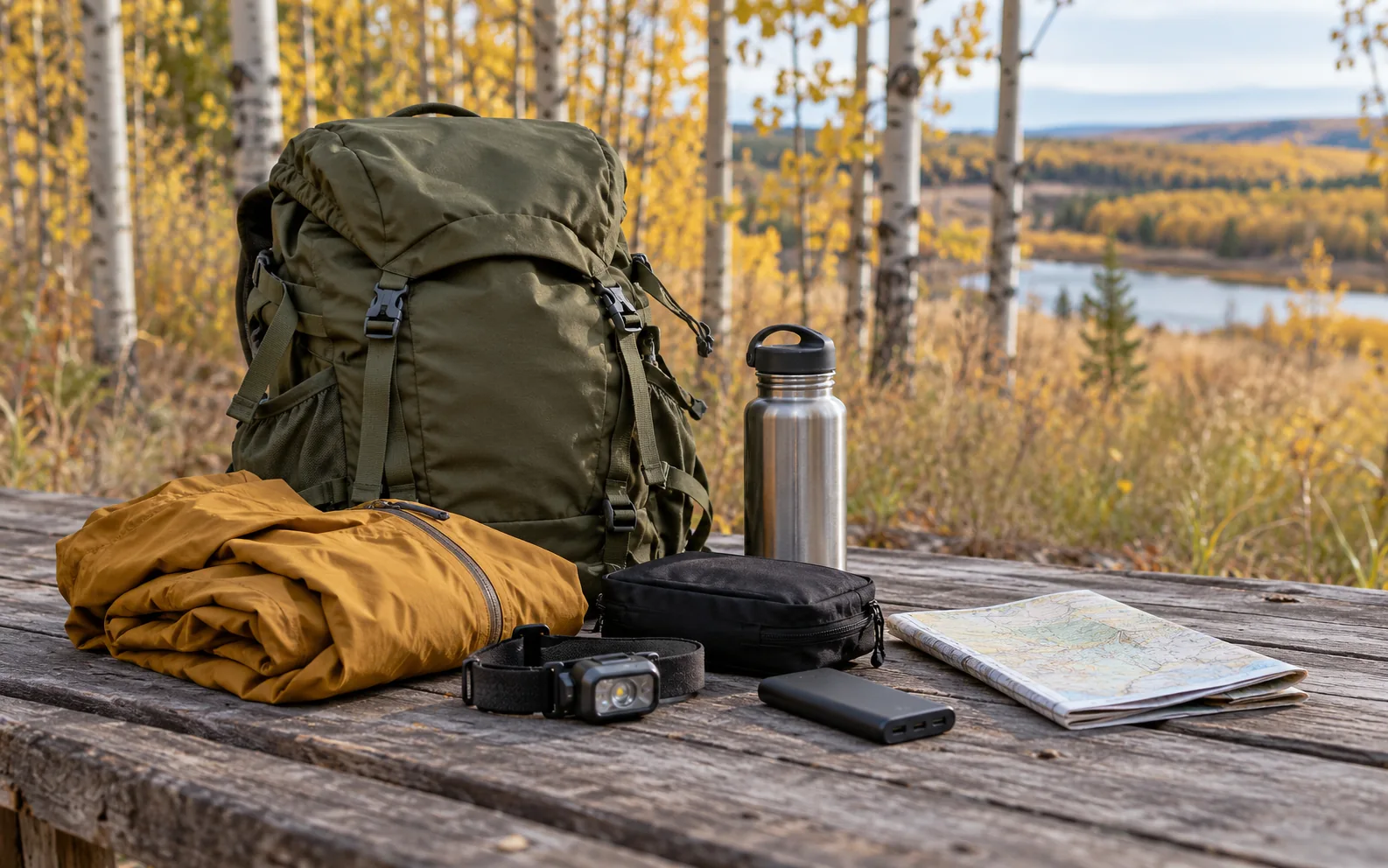
Original AI-generated photo-style teaching scene for SKHunter; depicted people, documents and maps are illustrative.
Image credit: SKHunter · original AI-generated photo-style imageWhat you will learn
- Build a plan backwards from the return time.
- Use explicit cancellation and turnaround triggers.
- Prepare a fallback that has its own completed checks.
An original SKHunter learning guide
Give every outing a complete return path
Teaching diagram · not a map- 01Before leaving
Check the destination, conditions, documents and return-time contact.
- 02At the location
Compare the actual conditions with your plan, and change or stop when needed.
- 03After returning
Close the check-in, record what changed and follow up on your tasks.
A backup place needs its own checks. A cancelled outing can still produce a useful observation and a better next plan.
Budget the day from the return backwards
Begin with the time you must be back or check in, then reserve the return journey, packing, an uncertainty margin and the outward journey. What remains is the actual visit time. This often reveals that a closer parcel is more realistic than the largest parcel on your shortlist.
Treat navigation estimates as one input rather than a promise. Add time for finding an unfamiliar rural approach and stopping to confirm a location. Put a clear turnaround point in the plan. When the outward journey takes longer than expected, reduce the visit rather than borrowing automatically from the time reserved for returning.
Make the cancellation rules visible
Write a few observable conditions that change the plan: access cannot be confirmed, the approach differs from the agreed route, weather exceeds your preparation, or a required device or document is missing. Match each trigger with an action such as clarify, use the prepared alternative or return.
Discuss these rules with companions before departure. An agreement made in advance is easier to follow than a debate after a long drive. Give everyone a way to raise a concern without having to prove that the situation is already dangerous. A cancelled visit can still produce useful information for the next plan.
Pack by failure, then rehearse
Instead of buying from a generic list, ask what happens if the phone loses reception, the visit runs late, clothing becomes wet or the vehicle cannot continue. Choose appropriate backups within your skills and the conditions, and seek relevant training where necessary. Do not make unfamiliar equipment the only emergency plan.
Before leaving, explain the destination and check-in arrangement to a trusted person. Open offline maps and documents on the actual device, check power and keep essential information accessible. Your alternative destination should already have its own access, route and requirements checks; nearby does not mean interchangeable.
Worked example: the outward journey takes longer
Road conditions make the drive slower than expected. You have already used part of the time reserved for the visit, while the agreed check-in time has not changed.
Put it into practice
- Recalculate the remaining day using the return journey and margin first.
- Shorten or cancel the visit instead of silently extending the return time.
- Use a prepared alternative only if it still fits and its checks remain valid.
- Follow the agreed communication arrangement and record the road issue afterwards.
Build a day plan you can explain
A 36-second photographic motion explainer with gentle camera movement, four clear chapters and large on-screen words. Silent; optional captions and a transcript are available.
Choose a section or use the player controls. A text transcript is available below.
Read the video transcript
- 0:00
Start with a short list — Choose a main destination and a separately checked alternative.
- 0:09
Check the last kilometre — Confirm the approach, entrance and parking before starting directions.
- 0:18
Plan the return — Set a return time and tell a trusted contact your plan.
- 0:27
Save a usable trip pack — Keep required documents, contacts and notes accessible offline.
Common mistakes to avoid
Using every available hour for the visit
Reserve travel, packing and an uncertainty margin before setting the visit length.
Keeping the same plan after a major delay
Recalculate from the return time when conditions change.
Calling unprepared equipment an emergency backup
Use reliable arrangements and skills you have practised.
The drive takes an extra hour. Which part should you recalculate first?
- How to make the visit longer.
- The return journey, margin and remaining visit time.
- Whether a nearby unchecked parcel saves enough time.
Show the answer and explanation
Answer: B. The return journey, margin and remaining visit time.
Work backwards from the return commitment. A delay is a reason to shorten or cancel, not automatically remove the margin or improvise access.
Terms on this page
Open a term for its meaning, a common mix-up and the existing guide. English terms and acronyms are retained.
retrieval / recovery
The separate plan for finding and bringing back a bird or animal described by an outing.
Common mix-up: A return plan for people does not describe every animal-retrieval task; keep recovery limits visible.
Current checks and official context
Check every destination separately
Choose a primary parcel and an alternative that also has completed access and season checks. Confirm road conditions, parking and the final approach. Straight-line distance helps compare locations; use the navigation service for the road route and leave additional time for unfamiliar rural roads.
- Save the parcel description and a checked entrance.
- Keep permission conditions and required documents available offline.
- Check current weather and any local closure information.
Plan for the part of the day without reception
Tell a trusted contact where you intend to go and when you expect to return. Agree what they should do if you fail to check in. Carry navigation backups, appropriate clothing, water, food, first-aid supplies and a way to obtain help suitable for the area. Choose equipment for your trip and training level.
- Charge devices and test your offline information.
- Set a turnaround time and identify conditions that cancel the outing.
- Keep an alternative destination rather than improvising access to nearby land.
Leave time for the return and the records
Plan any required reporting, tagging or testing arrangements before you need them. After the trip, log the date, route problems, access changes and observations while they are fresh. Update an unusable entrance promptly so it does not become the assumed destination on the next trip.
Turn this lesson into your next outing
Review the date, species, starting template and linked day plan in an editable preparation draft. You choose what to add and save.
Prepare your own trip
Review a preparation draftContinue learning
Ask for land access and keep a useful permission recordTry a practical situation
The shorter approach crosses a neighbourOpening a draft does not create a saved checklist. A checked item records your own review, not permission or an open season.
Scenario practice
Put your field decisions into practice.
Try 24 situations across identification, access, field adjustments and harvest care. Compare your choice with the explanation, then revisit the relevant lesson.
Original sources
- Government of Saskatchewan · Hunters Guide and updates
- Government of Saskatchewan · Hunters Extras, maps and access
- Royal Canadian Mounted Police · Firearms safety and licensing
Use this as a planning guide. Check current official requirements and site conditions before travelling.
Help improve this guide
Tell the editor about something on this public page that needs attention.