
Guest reading progress stays in this browser and is not synchronized to your account automatically. Use the learning panel to include browser marks and save them explicitly. Clearing site data removes browser marks.
Your learning notebook
Save courses and review situations deliberately. Load your account records on another device when you want to continue.
Bookmarks and review choices stay in this browser until you load and save an account. Answers and time spent reading are not recorded.
Saved courses
Saved situations to revisit
Find your marked situations by title or topic, then open the original question and explanation.
Your review choices will appear here when this learning view is ready. Use the account controls above to load account choices.
No situations are marked for review in this learning view.
No saved situation matches these filters. Clear the search or choose all topics.
Identification practice
Land access practice
Field decisions practice
Harvest care practice
Ask for one visit, with the whole approach visible ↓
Beginner field workshop
Ask for one visit, with the whole approach visible
Give the person a request they can understand and decline. A small sketch with three labels—parking, crossing and activity area—helps you ask precise questions without treating all three as one permission.
Fictional teaching material, not a permission document. Parcel A, Parcel B and the labels below do not describe a real property or a route you may use. Confirm the actual parcel, the person’s authority and the current arrangements yourself.
The table scrolls independently. Focus it and use the arrow keys to see every column.
| Part of the request | Say or show | What an answer still needs to establish |
|---|---|---|
| Exact land | The legal description and a marked activity area on Parcel A. | Whether this is the land the person can authorize. |
| Parking | A separate label P for the intended vehicle position. | Whether parking there is included, and any arrival instructions. |
| Approach / crossing | The whole line from P to the activity area, including Parcel B if crossed. | Who can authorize every part; an answer for A does not settle B. |
| People, activity and date | The actual people, purpose and proposed visit period. | The scope of this answer rather than a standing invitation. |
| Conditions and return | Ask about gates, farming activity, dogs, the return route and how to report a change. | Which conditions were actually agreed, including anything still unanswered. |
Practise the conversation and the change
The reply says “You can park there.” Does it cover the activity area?
Keep that answer attached to parking P. Read back the activity, people, period and approach as separate questions instead of expanding a parking answer into permission for the whole outing.
If a part remains unanswered, do not resolve it by guessing. Keep the visit pending or use another independently checked plan.
The weather changes and a friend joins tomorrow. Can you reuse today’s answer?
List the changes—date, party and any route or activity change—then ask whether the earlier arrangement covers them. Do not rewrite the old note as though the new details were already agreed.
Keep the original answer and any later confirmation dated. If you cannot clarify the new plan, choose an arrangement you can actually confirm.
How do you finish a request after a refusal?
Thank the person, acknowledge the refusal and end the request without pressure. A courteous response can be as simple as: “Understood, thank you for letting me know. We will use another plan.”
Keep a private note of the scope and date so you do not repeat the same request by accident. A contact name is still not authorization for neighbouring land.
Check actual requirements with the official sources
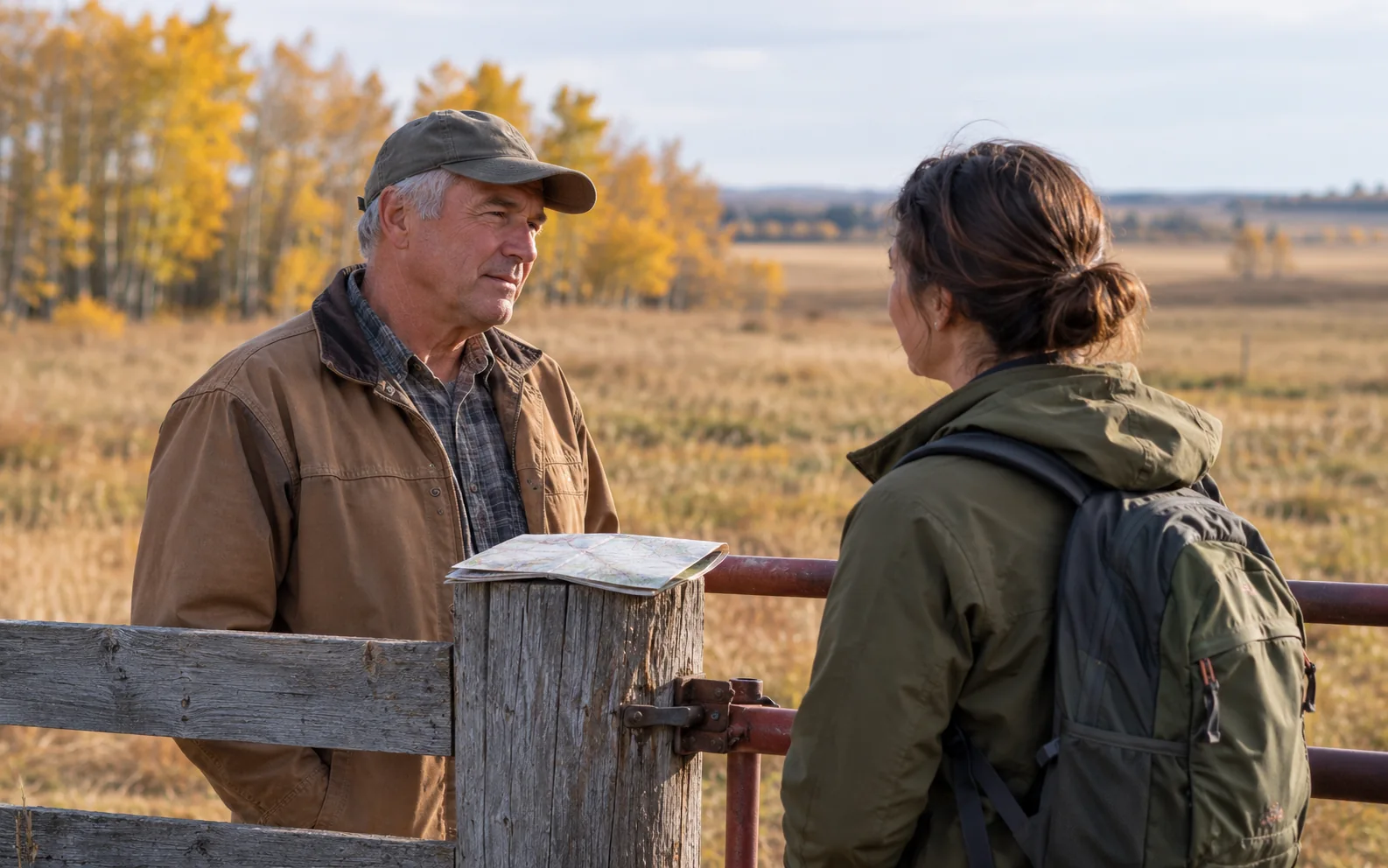
Original AI-generated photo-style teaching scene for SKHunter; depicted people, documents and maps are illustrative.
Image credit: SKHunter · original AI-generated photo-style imageWhat you will learn
- Prepare a clear parcel-specific access request.
- Turn an answer into a usable private record.
- Distinguish a contact lead from confirmed authority and permission.
An original SKHunter learning guide
Keep three different questions separate
Teaching diagram · not a map- 01The land
Who can authorise this visit, and what conditions apply?
- 02The hunt
Do the current species, zone, date and personal licence conditions match?
- 03The approach
Can you reach the place and return by a checked, lawful route?
A favourable answer to one question does not answer the other two. Keep the evidence for each check.
Prepare the request before making contact
A clear request is easier to answer than “Can I hunt around here?” Prepare the legal land description, a simple map and the proposed people, activity, dates and approach. Mark the place you hope to park separately from the area you hope to visit. These details reveal whether more than one property is involved.
Treat a name from a map or a neighbour as a contact lead, not an established permission. Confirm that you have the right parcel and that the person can authorise the visit. Keep the request short, courteous and easy to decline. A refusal is an answer to record and respect, not a reason to keep negotiating at the gate.
Read the answer back as conditions
Translate the reply into a practical visit note: covered parcel, permitted people, activity, period, approach and any limits stated by the person. Repeat unclear details back in your own words and ask whether you have understood correctly. Do not quietly broaden “this afternoon” into a standing arrangement.
Record the original message or your accurate note of the conversation privately, together with the source and confirmation date. Keep personal contact details out of shared public links. Add a reminder to recheck any condition that can change, such as farm activity or the agreed parking place, instead of marking the entire parcel permanently available.
Use an arrival pause, not an automatic entry
Before entering, compare the agreed plan with what is actually present. An unexpected sign, activity, closed approach or condition that contradicts your notes is a reason to stop and clarify. Do not solve an access problem by crossing adjacent land that has not been separately checked.
If the visit is cancelled, preserve the useful record and explain why it could not proceed. Change an entrance point to unavailable or unconfirmed when appropriate. On the next trip, start with the dated arrangement and current conditions rather than assuming a successful previous visit settled every future request.
Worked example: one reply, two parcels
A contact agrees to a visit on one legal description. Your preferred approach crosses a second parcel that was not mentioned in the conversation.
Put it into practice
- Draw the entire approach and identify the second parcel.
- Ask who can authorise that part of the route and check it separately.
- Save the exact scope and conditions of each answer privately.
- Use another checked approach or cancel if the route remains unresolved.
Four checks before the field
A 36-second photographic motion explainer with gentle camera movement, four clear chapters and large on-screen words. Silent; optional captions and a transcript are available.
Choose a section or use the player controls. A text transcript is available below.
Read the video transcript
- 0:00
Start with the parcel — Identify the exact land and the surrounding approach.
- 0:09
Check land permission — Confirm who may enter, when, and under which conditions.
- 0:18
Read the complete season row — Match species, zone, licence and date. Read the attached notes.
- 0:27
Verify a usable route — A parcel pin is not an entrance. Keep a checked fallback.
Common mistakes to avoid
Saving only a phone number
Without the parcel, authority, date and conditions, a number is merely a lead.
Treating a friendly reply as unlimited access
Confirm the people, purpose, dates and exact land covered.
Using a neighbour’s land as a convenient shortcut
The approach needs its own complete access checks.
You have a contact’s name and phone number from an old map. What does that establish?
- Permission for the current visit.
- A lead that still needs parcel, authority and permission checks.
- Permission to cross neighbouring land.
Show the answer and explanation
Answer: B. A lead that still needs parcel, authority and permission checks.
Contact information helps you ask the right questions. It is not itself a current answer about access.
Terms on this page
Open a term for its meaning, a common mix-up and the existing guide. English terms and acronyms are retained.
quarter section
A directional quarter of a section in a rural legal land description, commonly labelled NE, NW, SE or SW.
Common mix-up: A land-description reference does not itself provide a checked entrance or the boundary geometry shown by a map record.
FWDF
Fish and Wildlife Development Fund; the collection label used here for the published FWDF land records.
Common mix-up: A directory row and a GIS polygon are different record units. Do not assume a one-to-one match.
SWF Habitat Trust Lands
The Habitat Trust collection presented separately under Saskatchewan Wildlife Federation in the map guide.
Common mix-up: An SWF reference location does not supply the boundary of a nearby FWDF polygon.
retrieval / recovery
The separate plan for finding and bringing back a bird or animal described by an outing.
Common mix-up: A return plan for people does not describe every animal-retrieval task; keep recovery limits visible.
Current checks and official context
Identify exactly what land you are asking about
Use the legal land description and a map to identify the intended parcel. Check the evidence behind its land category and ownership information. FWDF ownership arrangements, SWF references, leased Crown land and private land can have different access conditions; a manager’s name alone does not settle ownership.
- Check neighbouring land crossed by the approach.
- Ask the local RM office about available landowner-map information.
- Confirm that the person giving permission can authorise the visit.
Make a specific and respectful request
For private land, obtain the owner or occupant’s permission before entry. Explain who will visit, when, for what activity and how you intend to enter. The provincial fact sheet accepts verbal, written and electronic permission and recommends a written or electronic record. Silence is not a usable permission record.
- Ask about gates, livestock, crops, parking and vehicle use.
- Confirm which parcel and which people the answer covers.
- Accept a refusal and leave room for access conditions to change.
Save the conditions, then recheck on arrival
In Land contacts, save the source, contact details, confirmation date, period and agreed conditions. Copy the actual message when appropriate, keeping it private. Check current signs and your agreed route on arrival. A saved record helps you remember the arrangement; it does not extend the permission to another date, person or property.
Turn this lesson into your next outing
Review the date, species, starting template and linked day plan in an editable preparation draft. You choose what to add and save.
Prepare your own trip
Review a preparation draftContinue learning
Read a WMZ and season table without skipping conditionsTry a practical situation
A permission message with limitsOpening a draft does not create a saved checklist. A checked item records your own review, not permission or an open season.
Scenario practice
Put your field decisions into practice.
Try 24 situations across identification, access, field adjustments and harvest care. Compare your choice with the explanation, then revisit the relevant lesson.
Original sources
Use this as a planning guide. Check current official requirements and site conditions before travelling.
Help improve this guide
Tell the editor about something on this public page that needs attention.