
Guest reading progress stays in this browser and is not synchronized to your account automatically. Use the learning panel to include browser marks and save them explicitly. Clearing site data removes browser marks.
Your learning notebook
Save courses and review situations deliberately. Load your account records on another device when you want to continue.
Bookmarks and review choices stay in this browser until you load and save an account. Answers and time spent reading are not recorded.
Saved courses
Saved situations to revisit
Find your marked situations by title or topic, then open the original question and explanation.
Your review choices will appear here when this learning view is ready. Use the account controls above to load account choices.
No situations are marked for review in this learning view.
No saved situation matches these filters. Clear the search or choose all topics.
Identification practice
Land access practice
Field decisions practice
Harvest care practice
Follow one animal from the private packing list to the matching CWD result ↓
Follow one animal from the private packing list to the matching CWD result
Rehearse the paperwork before the trip using empty packages and invented codes. The task is to keep the animal, its packages, the submitted sample and the returned information connected, even when different people handle each stage.
Original fictional record exercise. EX-A, EX-B and EX-S-A are teaching codes, not official licence, seal, sample or laboratory identifiers. This lesson creates no account record or submission. It does not teach sampling, diagnose disease or establish that meat is safe. Use the current Saskatchewan submission and handling instructions for the real animal.
A result needs an unbroken link back to the animal
Each arrow means “match the records”; it is not a guarantee of test accuracy or food safety.
- Animal and official record
Identify the animal and retain the applicable licence and seal information separately.
- Associated packages
Keep a private list connecting every package to that animal.
- Sample and receipt
Match the actual submission reference and receiving information.
- Returned information
Read the result with the matching identifier and official instructions.
This five-column table scrolls independently. Focus it and use the arrow keys to follow a row from left to right.
| Private animal code | Official licence / seal record | Private package list | Sample / receiving record | Returned information |
|---|---|---|---|---|
| EX-A | [Actual holder and applicable official record, kept privately] | EX-A-1; EX-A-2 | EX-S-A; submission link still to be checked | No matched result recorded |
| EX-B | [Separate actual holder and applicable official record] | EX-B-1 | [Actual sample reference not yet reconciled] | A message mentions a different reference; unresolved |
A completed row is a traceability aid, not a test result. “A result arrived” is insufficient when its identifier does not match the animal and submission record. Keep unmatched information visibly unresolved while checking with the appropriate official service.
Before calling a record matched, point to the evidence
Use a separate private copy for real identifiers. This public example uses placeholders and sends no animal, contact or location details anywhere.
- Animal identity
- [Which single animal does this row describe?]
- Official records
- [Which actual holder, licence and seal information applies?]
- Packages
- [Can every package be traced to that same animal?]
- Submission link
- [Which actual sample reference and receiving record match?]
- Returned information
- [Does this result identifier match that exact submission?]
Test the chain with a companion
- Place two empty packages labelled EX-A-1 and EX-A-2 beside the EX-A record. Ask a companion to find their animal without relying on where they sit.
- Introduce a pretend result bearing a different identifier. Leave its status unresolved; explain which submission or receiving information you would compare before contacting the official service.
- Practise the handover of the written record as well as the packages. Keep applicable official licence and seal requirements distinct from your own organisational codes.
Three gaps to resolve without guessing
The sample reference is missing from your private packing list. What can you still say?
You can describe the packages linked to EX-A, but the list does not yet connect them to an actual sample submission. A private animal code is not automatically a laboratory or submission identifier.
Recover the actual submission or receiving information through the appropriate official process and reconcile it with the animal record. Until that link is established, keep the test status unconfirmed rather than copying another animal’s identifier.
A result arrives with a different identifier. Why leave the row unresolved?
A result for another reference does not become a result for EX-B because it arrived at a convenient time or in the same message thread. Compare the exact identifiers and the recorded submission information.
Keep both the original message and the unresolved link; ask the appropriate official service to clarify the discrepancy. Do not change a package label to make it agree with an unexplained result or infer safety from an unverified match.
One animal’s packages go to two destinations. What travels with each part?
Location alone is a weak link: EX-A-1 may be in one place and EX-A-2 in another while both still belong to the EX-A record. Each receiving person needs the relevant animal-to-package link and the status that is actually known.
Reconcile the two destinations against the original package list and keep the real sample reference connected to that same animal. Follow the applicable handling, transfer and official record requirements separately; a private code does not replace them.
Official submission and handling instructions
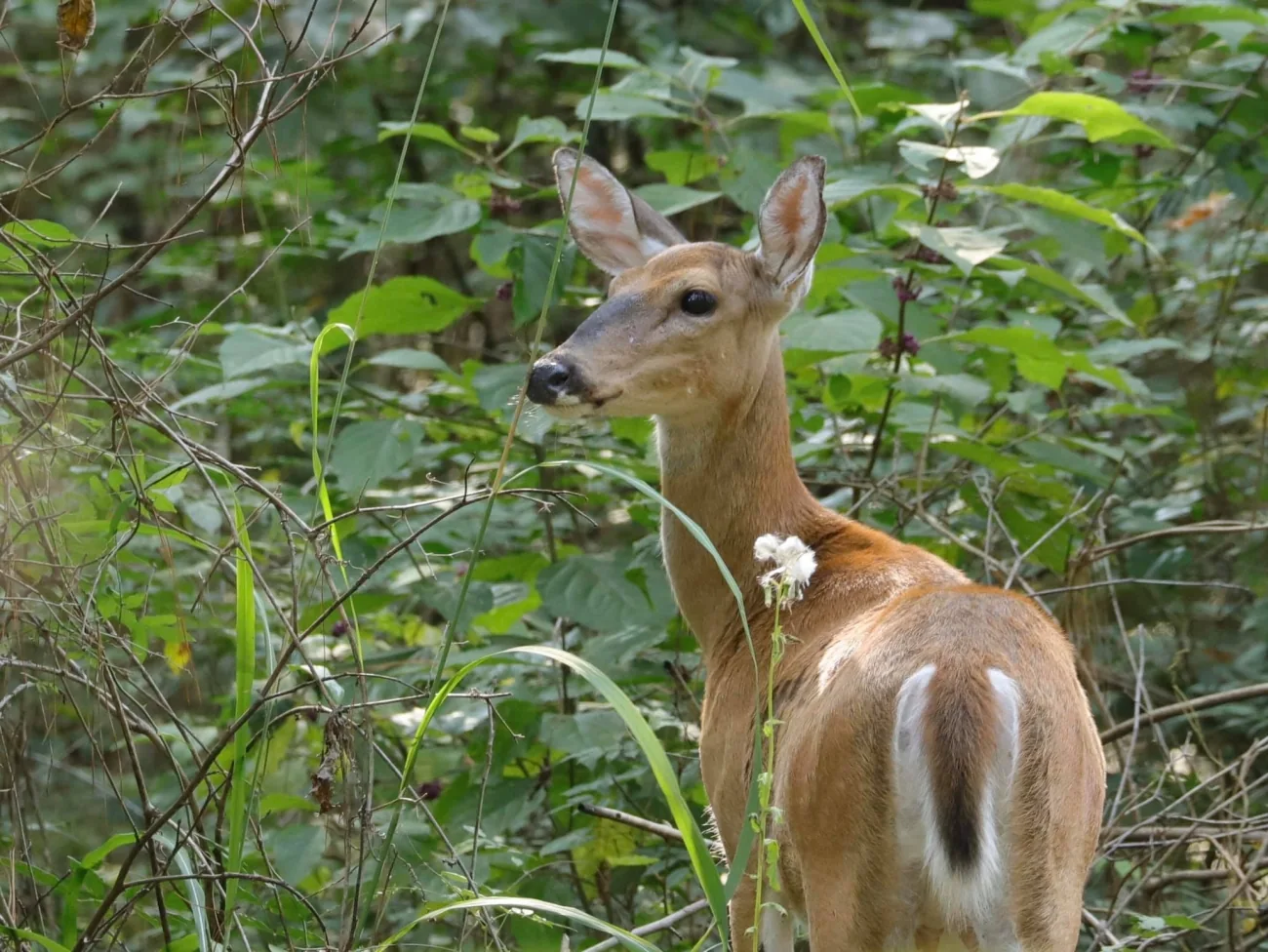
Representative photograph from the credited source, taken outside Saskatchewan. It is not a current sighting, a distribution map or a complete identification guide.
Image credit: Regina Snow/USFWS · Public Domain · View image sourceWhat you will learn
- Plan the administrative path before departure.
- Keep a sample reference linked to the correct private record.
- Record pending or unusable results without guessing.
An original SKHunter learning guide
Give every outing a complete return path
Teaching diagram · not a map- 01Before leaving
Check the destination, conditions, documents and return-time contact.
- 02At the location
Compare the actual conditions with your plan, and change or stop when needed.
- 03After returning
Close the check-in, record what changed and follow up on your tasks.
A backup place needs its own checks. A cancelled outing can still produce a useful observation and a better next plan.
Draw the information journey
Use a simple sequence: outing details, current requirement check, receiving arrangements, submission reference, result and follow-up. Write down where each piece of information will come from and who in the group will keep it. Planning this at home avoids searching unfamiliar services when devices are cold, tired or offline.
Keep the species, location and relevant licence details with the trip record so you can consult the current official instructions accurately. Open the receiving-location information before travelling and consider what you will do if the intended site cannot accept the submission. This lesson explains organisation, not sample collection or medical advice.
Use one private reference consistently
Choose an unambiguous private record name and keep it attached to the animal-related notes and the official submission reference. Avoid a group message that says only “the first one” when several people or visits are involved. Write the reference carefully and check it against the original instead of relying on memory.
Record the submission date, receiving location and a status such as planned, submitted or awaiting result. Store photographs or supporting documents privately if you use them. Do not put identifiers or precise personal trip details into a public article, shared search URL or publicly accessible photograph.
Keep status and interpretation separate
A submission receipt shows a step in the process; it is not a result. A pending or unsuitable result remains that status until the responsible service provides further information. Record the wording and date of the official response, then follow current ministry and public-health guidance for the next action.
If the expected response has not arrived, use the official follow-up channel with the reference you saved. Do not convert a delay into an assumed negative result or use the appearance of an animal to replace testing guidance. Keep any question about consumption, handling or disposal for the appropriate qualified authority.
Worked example: the group has two submission records
Two people return from different outings and both describe their submission as “the deer sample.” The notes need to be clear enough to avoid mixing the records.
Put it into practice
- Give each private outing record an unambiguous name.
- Copy and verify the official reference against its original record.
- Attach the receiving location, date and current status to the matching entry.
- Check each result separately and follow the appropriate official next steps.
Build a day plan you can explain
A 36-second photographic motion explainer with gentle camera movement, four clear chapters and large on-screen words. Silent; optional captions and a transcript are available.
Choose a section or use the player controls. A text transcript is available below.
Read the video transcript
- 0:00
Start with a short list — Choose a main destination and a separately checked alternative.
- 0:09
Check the last kilometre — Confirm the approach, entrance and parking before starting directions.
- 0:18
Plan the return — Set a return time and tell a trusted contact your plan.
- 0:27
Save a usable trip pack — Keep required documents, contacts and notes accessible offline.
Common mistakes to avoid
Treating a receipt as a negative result
Track submission and result as different states.
Relying on an animal’s appearance
Appearance does not replace official testing or health guidance.
Losing the association between records
Use a consistent private reference and verify it against the original.
The submission is recorded, but the result has not arrived. What status is accurate?
- Awaiting result.
- Negative.
- No further follow-up needed.
Show the answer and explanation
Answer: A. Awaiting result.
A completed submission establishes only that stage of the process. Preserve the pending status and use the official follow-up route when needed.
Current checks and official context
Match the requirement to your hunt
Start with the current Getting Your Animal Tested page, then match the harvested species, WMZ and licence category. Following the October 22 update, the detailed page says the provincial program has been reinstated. Confirm the applicable requirements directly; a general headline is not enough to decide an individual licence condition.
- Keep the WMZ, species and licence information together.
- Check current receiving locations and instructions before travelling.
- Ask the ministry when pages or dates appear inconsistent.
Prepare the administrative steps in advance
The provincial instructions require a unique CWD tracking number, obtained through the linked submission service, to accompany a submitted head. Before the trip, open that service, identify the information you will need and choose a receiving site. Follow the current official preparation instructions; arrange specialist handling if you need to preserve a trophy.
- Record the tracking number and submission date privately.
- Check the location’s opening hours and sample capacity.
- Keep a clear association between the animal, sample and stored meat.
Keep the result and follow-up attached to the record
Save the submission reference and return to the official results service. Treat a pending, unsuitable or unavailable result as its own status; do not replace it with an assumed negative. Follow current public-health and ministry advice on consumption, handling and disposal, and ask a qualified authority about your particular situation.
Turn this lesson into your next outing
Review the date, species, starting template and linked day plan in an editable preparation draft. You choose what to add and save.
Prepare your own trip
Review a preparation draftContinue learning
Read a WMZ and season table without skipping conditionsTry a practical situation
A submitted CWD sample is not a resultOpening a draft does not create a saved checklist. A checked item records your own review, not permission or an open season.
Scenario practice
Put your field decisions into practice.
Try 24 situations across identification, access, field adjustments and harvest care. Compare your choice with the explanation, then revisit the relevant lesson.
Original sources
- Government of Saskatchewan · Getting Your Animal Tested
- Government of Saskatchewan · CWD testing update, October 22, 2026
Use this as a planning guide. Check current official requirements and site conditions before travelling.
Help improve this guide
Tell the editor about something on this public page that needs attention.