
Guest reading progress stays in this browser and is not synchronized to your account automatically. Use the learning panel to include browser marks and save them explicitly. Clearing site data removes browser marks.
Your learning notebook
Save courses and review situations deliberately. Load your account records on another device when you want to continue.
Bookmarks and review choices stay in this browser until you load and save an account. Answers and time spent reading are not recorded.
Saved courses
Saved situations to revisit
Find your marked situations by title or topic, then open the original question and explanation.
Your review choices will appear here when this learning view is ready. Use the account controls above to load account choices.
No situations are marked for review in this learning view.
No saved situation matches these filters. Clear the search or choose all topics.
Identification practice
Land access practice
Field decisions practice
Harvest care practice
Useful reading before this lesson
Start with these guides for background and preparation. You can open any guide at any time.
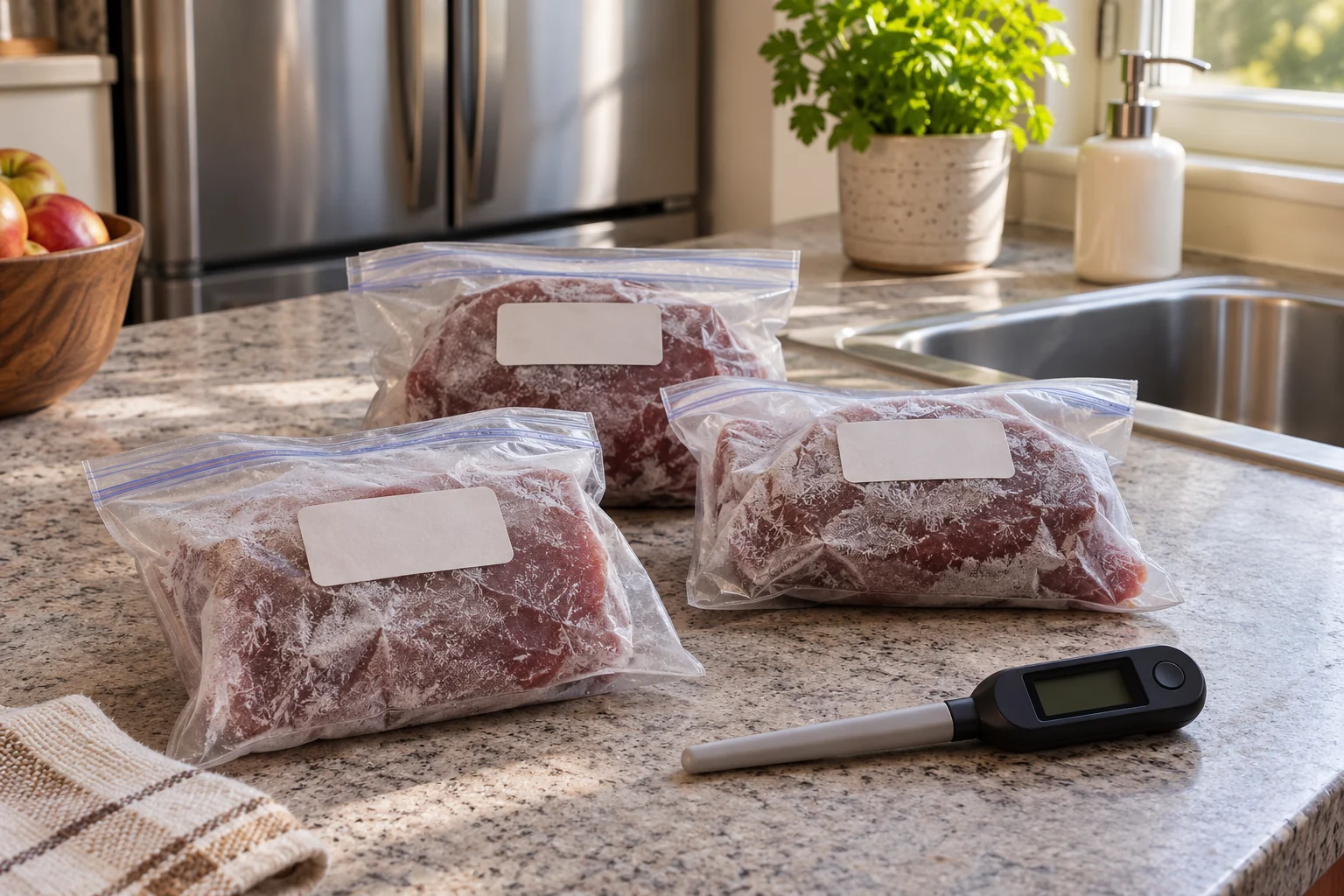
Original AI-generated teaching photograph of prepared supplies. The scene illustrates organisation, not a complete equipment list or a measurement of food temperature.
Image credit: SKHunter · original AI-generated teaching photographWhat you will learn
- Keep identity and health status attached to packages through storage.
- Choose a safe thawing method and prevent raw-to-ready contamination.
- Match the actual food to the official cooking category and measure it.
An original SKHunter learning guide
Keep identity and temperature checks through the kitchen
Use the official category for the actual food, and measure rather than relying on colour or a recipe timer.
Conceptual workflow · read the complete lesson below
- 01
Verify and label
Keep species, animal or batch, cut, dates and relevant status with each package. Clarify missing handling information before discarding temporary labels.
- 02
Organise cold storage
Check the refrigerator and freezer with thermometers. Contain raw foods separately and keep each animal’s status traceable.
- 03
Plan thawing and separation
Choose the package in advance, use the current safe thawing method and keep raw juices away from ready-to-eat food and clean utensils.
- 04
Measure and finish
Match the official temperature category to the meat, bird pieces or whole bird. Measure properly, serve with clean utensils and plan leftovers.
Review your own plan
- Does the cook know the package’s identity and relevant status?
- Which current official temperature category matches this food?
- Are clean utensils and labelled leftover containers ready?
Inspect the handover before putting food away
Set up a receiving page with one row per animal or batch: species, harvest date, package count, processing date, CWD status when relevant and any handling uncertainty. Check the labels against the person delivering them. If an important field is unknown, ask before erasing the temporary packaging. Do not quietly turn an uncertain cooling history into a confirmed one just because the meat has arrived home. Keep the information where the cook can find it, rather than only in a hunting-trip chat.
Use a small, readable storage system
Health Canada recommends a refrigerator at 4°C or below and a freezer at −18°C or below. Keep raw meat contained below ready-to-eat food. Check with appliance thermometers and leave room for air circulation. Organise separate, clearly labelled trays for unresolved health status and food ready for the next appropriate step. Cooling, testing status and cooking are different questions; a neatly frozen package does not settle all three.
- Label: species, animal or batch code, cut, processing date and relevant status.
- Pack in meal-sized portions so the intended amount can be thawed.
- Keep a simple freezer inventory and use older suitable packages first.
- If a pack leaks or its identity is lost, isolate it and resolve the problem before use.
Plan tomorrow’s meal today
Choose the pack while it is still frozen, read its label and put it in a tray on the refrigerator’s bottom shelf to thaw. Health Canada identifies refrigeration as the safest thawing method; do not thaw meat on the counter. Microwave-thawed meat must be cooked immediately. If using cold water, keep the food in leak-proof packaging and follow the official method. A thicker pack needs more planning than a thin one; allow extra time instead of improvising with warm water when dinner is late.
Match the food to the right thermometer target
On the current Health Canada chart, game meats including ground venison and Deer, Elk or Moose are listed at 74°C. Game-bird or waterfowl pieces and stuffing are 74°C; a whole game bird is 82°C. These categories matter: do not copy the lower beef-steak row for wild game. Put the probe into the thickest centre without touching bone and check pieces individually. The chart’s Celsius values correspond to 165°F for 74°C and 180°F for 82°C.
- Before cooking, write the food category and target beside the recipe.
- Use a clean digital thermometer; clean it between raw and cooked checks.
- Choose a recipe that can reach the target without relying on colour or a set number of minutes.
- If one piece has not reached its target, continue cooking that piece and recheck.
Keep the serving stage in the plan
Put cooked food on clean dishes with clean utensils, away from the raw-meat station. Plan portions before serving so the remainder can be cooled promptly in shallow containers. Health Canada advises discarding cooked food left at room temperature more than two hours, using refrigerated leftovers within two to three days, and reheating leftovers to 74°C. Date each container while filling it. A large pot is a reason to divide the food for cooling rather than leaving it out until the whole pot feels cold.
Keep preservation claims within their limits
Freezing and ordinary cooking do not remove CWD prions from infected meat. Never use a cooking temperature, a freezer date or a good-looking cut to override a positive CWD result. Keep the affected animal’s identity through all packages and follow the responsible authority’s disposal advice. Drying, curing, smoking and home canning also need a validated process suited to the food; a tasty recipe is not proof of preservation safety. Choose a verified method before beginning, and seek public-health advice when the food or process does not fit it.
Practice: two packages, two cooking categories
You plan one meal from game-bird breast pieces and another from a whole game bird. A favourite recipe gives only an oven time.
Put it into practice
- Check the identity and relevant health status of each package.
- Schedule refrigerator thawing with a contained tray for each.
- Record 74°C for the pieces and 82°C for the whole game bird from the current official chart.
- Measure the food instead of assuming the oven time is enough.
- Use clean serving equipment and label leftovers with their date.
Common mistakes to avoid
Using meat colour as the final test
Use the applicable food category and a thermometer; appearance is not a reliable safety measurement.
Treating every bird as the same cooking category
Whole game birds and separate pieces have different targets on the Health Canada chart.
Calling freezing a CWD treatment
Freezing preserves storage conditions; it does not remove CWD prions or clear an animal’s status.
Which pair matches the current Health Canada categories for game birds?
- Pieces 74°C; whole game bird 82°C.
- All game birds 63°C.
- Whole game bird 74°C; pieces 60°C.
Show the answer and explanation
Answer: A. Pieces 74°C; whole game bird 82°C.
The chart distinguishes pieces and stuffing at 74°C from a whole game bird at 82°C. Use a thermometer and consult the current row for the actual food.
Current checks and official context
Use the chart for the actual food
Health Canada separates game meats, game-bird pieces and whole game birds. Cooking temperatures address ordinary foodborne hazards; they do not make CWD-positive meat safe to eat.
Keep handling and storage information
Freezer quality times are not a guarantee after poor field care. Review the current storage, thawing and leftovers guidance, and obtain professional advice about an uncertain cold chain or an unfamiliar preservation process.
Turn this lesson into your next outing
Review the date, species, starting template and linked day plan in an editable preparation draft. You choose what to add and save.
Prepare your own trip
Review a preparation draftContinue learning
Game birds after the harvest: clean handling, cooling and the journey homeTry a practical situation
Two coolers at the handoverOpening a draft does not create a saved checklist. A checked item records your own review, not permission or an open season.
Scenario practice
Put your field decisions into practice.
Try 24 situations across identification, access, field adjustments and harvest care. Compare your choice with the explanation, then revisit the relevant lesson.
Original sources
- Health Canada · Safe food storage
- Health Canada · Safely defrosting foods
- Health Canada · Safe cooking temperatures, including game meats and game birds
- Health Canada · Food safety tips for leftovers
- Minnesota Department of Natural Resources · CWD questions: cooking and freezing
- Health Canada · Chronic wasting disease and food
Use this as a planning guide. Check current official requirements and site conditions before travelling.
Help improve this guide
Tell the editor about something on this public page that needs attention.