
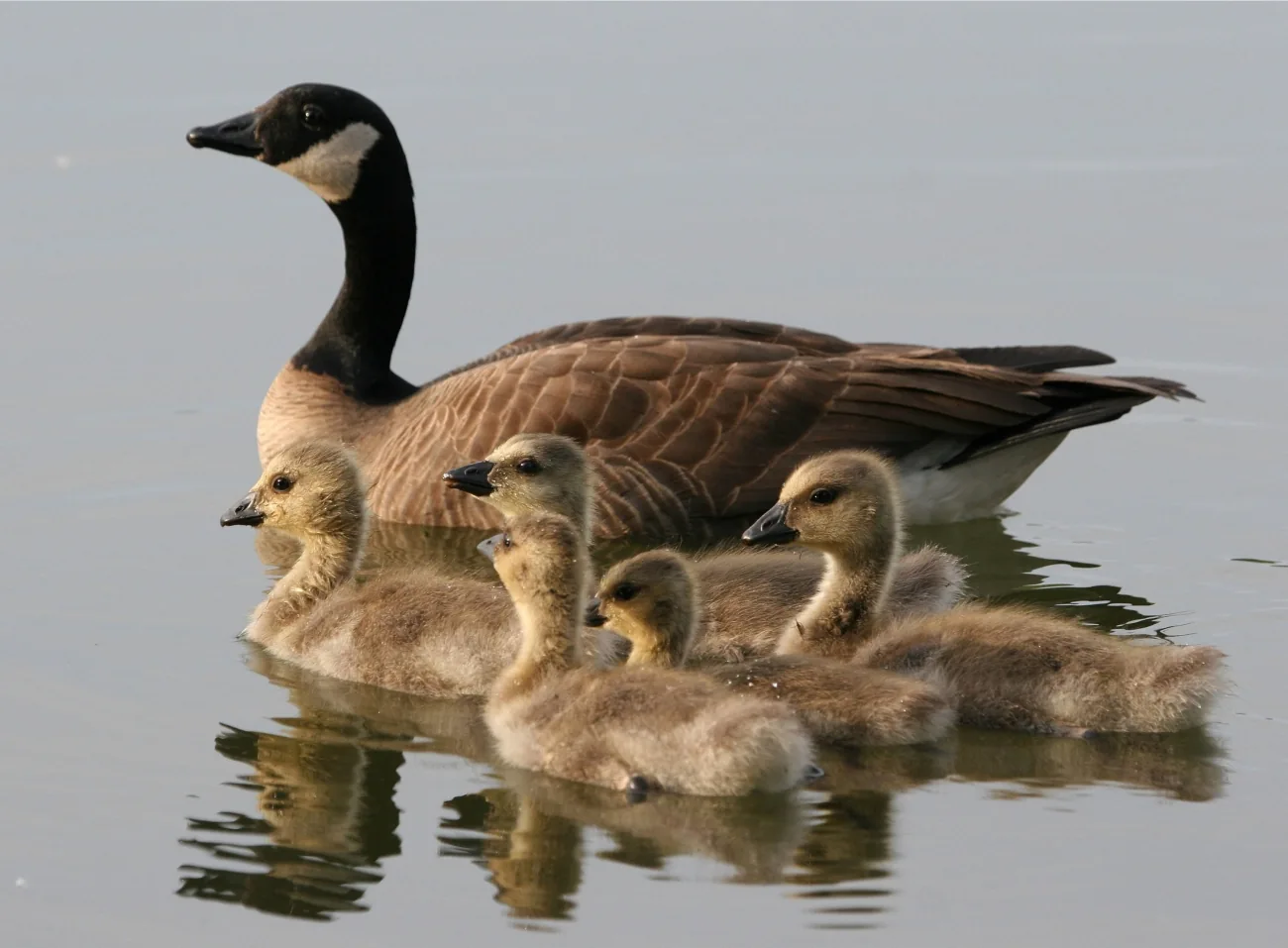
Representative photograph from the credited source, taken outside Saskatchewan. It is not a current sighting, a distribution map or a complete identification guide. This is one example from a wider bird group; other species, ages and plumages can look different.
Image credit: Donna A. Dewhurst/USFWS · Public Domain · View image sourceWhat you will learn
- Separate a broad goose group from an individual species.
- Recognise why plumage and apparent size can mislead.
- Keep count, location and confidence in a flock observation.
An original SKHunter learning guide
Build a record, not a prediction
Teaching diagram · not a map- 01Observe
Look from a lawful position without moving closer to obtain an answer.
- 02Describe
Record visible features, time, light, distance and behaviour.
- 03Keep uncertainty
Separate what you saw from what you think it might mean.
One clue starts a question. Several consistent observations build a better record; uncertainty remains a valid outcome.
Begin with a comparison, not a flock label
Canada Goose often presents a dark neck with a white cheek patch, but a distant dark-necked bird still deserves a careful comparison with similar species such as Cackling Goose. Compare bill and head proportions as well as the body, and remember that apparent size changes with distance. Use English names consistently when moving between an identification reference and a rules table. “Dark goose” can be a useful grouping for finding a reference; it is not a description of every feature on every individual in front of you.
White and dark are not separate identification systems
Snow Goose occurs in white and darker plumages. Ross’s Goose can resemble a white Snow Goose, with bill and head differences that may be difficult to see at distance. Start with a reference that shows both species and more than one plumage. Do not assign a species solely because the bird is white, small-looking or standing among larger birds. If the distinction is not visible, leave it unresolved. The biology comparison does not decide which current regulatory group, permit or special-season conditions apply to the intended outing.
Record a flock without inventing precision
For a large or partly hidden group, use a minimum count or a clearly labelled estimate. Note whether the birds were resting, feeding or passing through, and distinguish your observation point from the field they occupied. If a flock returns during the same visit, explain that it may be the same group. A field seen from a road still has its own ownership and access questions. Keep a dated observation separate from any permission request, and never treat yesterday’s count as a guarantee of tomorrow’s presence.
Worked example: pale birds among a distant flock
A mixed flock is visible beyond an authorised viewpoint. Several birds look white, but bill details are out of view.
Put it into practice
- Record a minimum visible count and describe the light and viewing distance.
- Keep the pale birds unresolved instead of assigning Snow Goose or Ross’s Goose from colour alone.
- Save the flock’s approximate field location separately from your observer position.
- Compare the species reference later and verify current species-specific requirements independently.
Turn a sighting into a useful note
A 36-second photographic motion explainer with gentle camera movement, four clear chapters and large on-screen words. Silent; optional captions and a transcript are available.
Choose a section or use the player controls. A text transcript is available below.
Read the video transcript
- 0:00
Describe what you actually saw — Record shape, markings and behaviour before assigning a species name.
- 0:09
Record the observation context — Add the date, viewpoint, light and approximate distance.
- 0:18
Keep uncertainty visible — A single track or a brief glimpse may remain unidentified.
- 0:27
Revisit without assuming — One sighting is not a population estimate or a promise for next time.
Common mistakes to avoid
Every white goose is Snow Goose
Ross’s Goose and other possibilities require a proper comparison; colour alone is insufficient.
Small-looking means a smaller species
Distance, posture and flock overlap can change apparent size.
A large flock has an exact total
An honest minimum or labelled estimate is better than false precision when birds are obscured.
You see white geese, but their bills are too distant to compare. What is the soundest record?
- All confirmed Snow Goose.
- Pale geese, species unresolved; bill details not visible.
- All confirmed Ross’s Goose because some look smaller.
Show the answer and explanation
Answer: B. Pale geese, species unresolved; bill details not visible.
The record keeps what was visible without inventing the features needed to distinguish similar species.
Current checks and official context
At a glance
- Canada Goose, Cackling Goose and white geese need careful comparison.
- A flight line does not establish use of a particular field.
- The map shortcut selects Canada/Cackling/White-fronted Geese; check white geese separately.
Habitat clues help plan a scouting visit. They do not establish that animals are present or that hunting is permitted.
Learn the comparison before counting a flock
Canada Geese use water and feeding areas such as grass or grain fields. Similar-looking geese can differ in size, bill and proportions, while flock composition can be mixed. Compare Canada Goose and Cackling Goose in a reference and learn Snow Goose and Ross’s Goose separately before choosing the regulatory group.
- Keep uncertain birds out of a confident species tally.
- Record a mixed flock as mixed when appropriate.
- Note where birds land rather than only their flight direction.
Connect observations with the exact property
Watch from a lawful location and record time, direction, landing location and activity. A nearby feeding field can belong to a different owner from the wetland where birds rest. Seek permission for the intended field and approach, confirm the latest agricultural conditions and recheck whether birds are still using the place before a later trip.
- Identify the parcel rather than just the nearest town.
- Ask about current crops, livestock, parking and routes.
- Keep contact details and any permission conditions private.
Choose the right federal group and season
Read the current federal Saskatchewan tables for the identified species group, then complete the provincial checks. Do not transfer a white-geese special measure to another group, or assume a general map shortcut has selected every species in a mixed flock. Check permits, limits, hours, methods and current local restrictions.
- Use the white-geese table for Snow Goose and Ross’s Goose.
- Recheck provincial licence conditions for any spring plan.
- Keep the exact source row with the trip notes.
Turn this lesson into your next outing
Review the date, species, starting template and linked day plan in an editable preparation draft. You choose what to add and save.
Prepare your own trip
Review a preparation draftContinue learning
A pre-trip checklist for waterfowl huntingTry a practical situation
Open related practiceOpening a draft does not create a saved checklist. A checked item records your own review, not permission or an open season.
Original sources
- Cornell Lab of Ornithology · Canada Goose life history
- Cornell Lab of Ornithology · Canada Goose and similar species
- Environment and Climate Change Canada · Saskatchewan migratory-bird summary
- Government of Saskatchewan · Current Hunters Guide and updates
- Cornell Lab of Ornithology · Canada Goose identification
- North Dakota Game and Fish · Lesser Snow Goose and Ross’s Goose
Use this as a planning guide. Check current official requirements and site conditions before travelling.
Help improve this guide
Tell the editor about something on this public page that needs attention.