
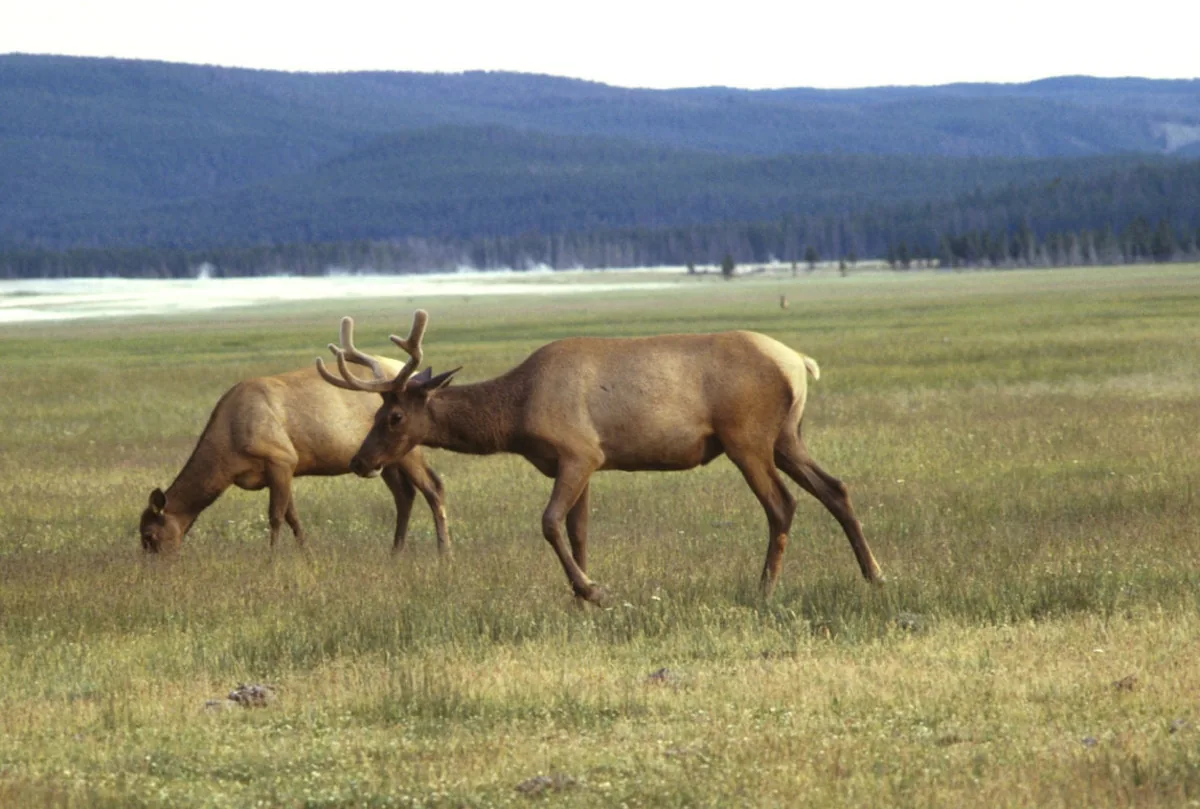
Representative photograph from the credited source, taken outside Saskatchewan. It is not a current sighting, a distribution map or a complete identification guide.
Image credit: Jim Leupold · via USFWS · Public Domain · View image sourceWhat you will learn
- Distinguish the North American name Elk from Moose.
- Describe animal activity without claiming a fixed pattern.
- Count groups transparently when some animals are hidden.
An original SKHunter learning guide
Build a record, not a prediction
Teaching diagram · not a map- 01Observe
Look from a lawful position without moving closer to obtain an answer.
- 02Describe
Record visible features, time, light, distance and behaviour.
- 03Keep uncertainty
Separate what you saw from what you think it might mean.
One clue starts a question. Several consistent observations build a better record; uncertainty remains a valid outcome.
Learn the silhouette as well as the name
In North American references, Elk means the animal also called wapiti; it does not mean Moose. Start by comparing body proportions, head and rump in clear reference images. Elk can show a pale rump and darker neck, while Moose have a notably long muzzle and long-legged outline. Antlers, when present and visible, add information, but a distant antlerless animal still needs identification. Write the English species name in your notes so a translation or a local nickname does not silently change which reference you consult.
Describe the activity you saw, not the whole season
Elk use different foods and can move between different landscape features. For learning, label the activity in front of you: feeding, resting, walking or obscured. Then add the vegetation and conditions you could observe. Do not turn one group seen in a meadow into a daily timetable or a promise that the same location will be occupied next week. A repeatable observation note is more useful than a confident prediction, especially when access, farm work, weather or the visible part of the landscape has changed.
Treat a group count as a measurement
If seven animals are visible while others may be behind trees, record “at least seven visible” rather than inventing a total. Keep the time, viewing duration and direction of travel with that count. If the same group disappears and reappears, explain that it may be a repeat observation rather than adding it as a new group. Photographs taken from a responsible distance can support later review, but neither a photograph nor a group count establishes the age, sex or current licence classification of every animal.
Worked example: a partly hidden group
From your permitted observation location you see seven Elk-like animals. Two are partly behind trees and the group later disappears.
Put it into practice
- Describe the visible identifying features and preserve uncertainty for obscured individuals.
- Record at least seven visible, with the time and the direction they moved.
- Mark any later reappearance as possibly the same group.
- Keep the biological observation separate from the current WMZ, licence and land-access review.
Turn a sighting into a useful note
A 36-second photographic motion explainer with gentle camera movement, four clear chapters and large on-screen words. Silent; optional captions and a transcript are available.
Choose a section or use the player controls. A text transcript is available below.
Read the video transcript
- 0:00
Describe what you actually saw — Record shape, markings and behaviour before assigning a species name.
- 0:09
Record the observation context — Add the date, viewpoint, light and approximate distance.
- 0:18
Keep uncertainty visible — A single track or a brief glimpse may remain unidentified.
- 0:27
Revisit without assuming — One sighting is not a population estimate or a promise for next time.
Common mistakes to avoid
Elk and Moose are interchangeable names
Different languages use these words differently; North American species names prevent a costly reference mix-up.
Every reappearance is a new group
Without evidence of distinct animals, repeated sightings may double-count the same group.
A group photo classifies each animal
Distance and overlap can hide the features needed for an individual classification.
Seven animals are visible, but trees hide part of the group. Which count is clearest?
- Exactly seven in the whole area.
- At least seven visible; other animals may be obscured.
- Fourteen because the group appeared twice.
Show the answer and explanation
Answer: B. At least seven visible; other animals may be obscured.
A minimum visible count states what you measured and what the view could not establish.
Current checks and official context
At a glance
- Elk may use a wider area than a single mapped parcel.
- Match the actual licence and any zone subdivision.
- Plan the lawful approach and retrieval logistics in advance.
Habitat clues help plan a scouting visit. They do not establish that animals are present or that hunting is permitted.
Learn the animal before interpreting signs
Elk often occur in groups and have a pale rump contrasting with a darker neck. Learn the body and antler comparisons in the linked wildlife reference. A call or group of tracks can be a scouting clue, but neither determines the animals’ current location, legal class or presence inside a particular boundary.
- Record what was seen as well as heard.
- Use photographs or reference notes only from a safe distance.
- Distinguish a confirmed sighting from an inferred travel route.
Make the visit practical for the whole party
Before committing to a parcel, map the lawful road approach, checked entrance and walking route. Think through daylight, terrain, communication and how the group will leave if access or conditions change. Record the permissions needed for the intended activity and any retrieval route instead of assuming permission extends across nearby land.
- Choose a feasible turnaround time.
- Keep a backup route or destination with completed checks.
- Revisit older observations rather than treating them as a forecast.
Read the exact Elk opportunity
Use the current guide and Elk opportunity updates to match residency, draw or regular licence, WMZ and any named subdivision. Read the row’s animal class, method and local notes together. Check current CWD obligations for the specific combination and preserve the official source with your trip plan.
- Verify the designation printed on your licence.
- Review current temporary or site-specific restrictions.
- Recheck documents and access if the group changes its destination.
Turn this lesson into your next outing
Review the date, species, starting template and linked day plan in an editable preparation draft. You choose what to add and save.
Prepare your own trip
Review a preparation draftContinue learning
Elk fieldcraft: organise openings, group observations and a realistic recovery planTry a practical situation
Open related practiceOpening a draft does not create a saved checklist. A checked item records your own review, not permission or an open season.
Original sources
- Hinterland Who’s Who · North American Elk
- Government of Saskatchewan · Current Hunters Guide and updates
- Government of Saskatchewan · 2026–27 hunting opportunities
- Government of Saskatchewan · Current CWD testing instructions
- U.S. National Park Service · Elk
- Missouri Department of Conservation · Elk identification
Use this as a planning guide. Check current official requirements and site conditions before travelling.
Help improve this guide
Tell the editor about something on this public page that needs attention.