
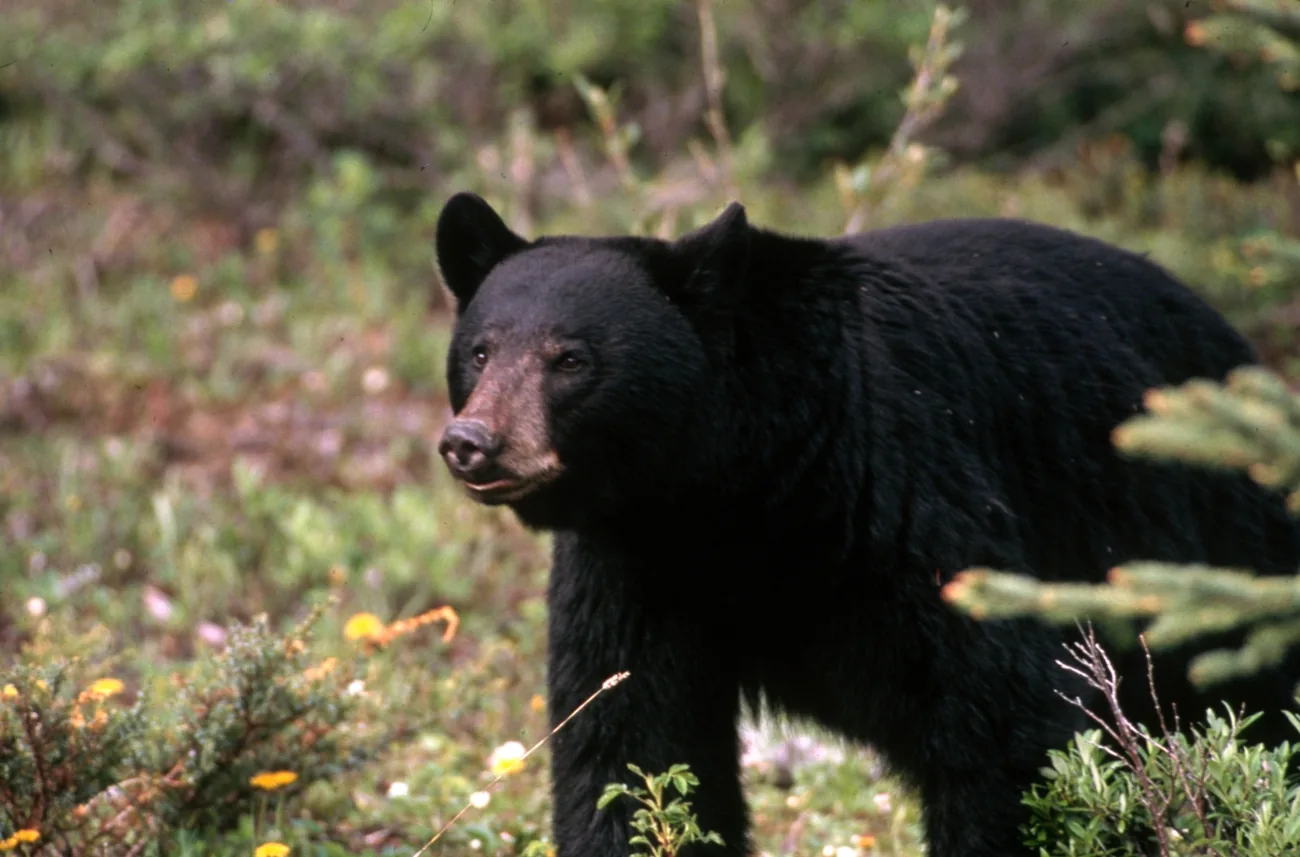
Representative photograph from the credited source, taken outside Saskatchewan. It is not a current sighting, a distribution map or a complete identification guide.
Image credit: U.S. Forest Service · Public Domain · View image sourceWhat you will learn
- Understand why coat colour is not a species test.
- Compare body features without approaching a bear.
- Separate evidence, interpretation and personal safety decisions.
An original SKHunter learning guide
Build a record, not a prediction
Teaching diagram · not a map- 01Observe
Look from a lawful position without moving closer to obtain an answer.
- 02Describe
Record visible features, time, light, distance and behaviour.
- 03Keep uncertainty
Separate what you saw from what you think it might mean.
One clue starts a question. Several consistent observations build a better record; uncertainty remains a valid outcome.
A species name is not a colour chart
Black Bear can have brown or lighter coats, and a dark bear is not automatically Black Bear. Compare the shoulder outline, facial profile and ears from a safe, undisturbed view. A prominent shoulder hump and dished facial profile are among the features used to compare Grizzly Bear with Black Bear, but angle, posture and vegetation can hide them. If a feature is concealed, label it concealed. An identification exercise should never become a reason to approach the animal or remain where you feel unsafe.
Understand why a bear is more than a sighting pin
Bears use changing food resources, including plant foods and other opportunities. A note about berries, vegetation or disturbed logs is useful context, but cannot establish which bear was there, how recently it visited or where it is now. Keep food and waste secure under the guidance applicable to your trip; do not create an attraction to improve an observation. Separate a wildlife sighting from a place you would park or stop. A spot that produced a photograph is not automatically a suitable place to linger.
Let uncertainty change the plan
Imagine two accounts of the same glimpse: one person saw a dark coat, another thought there was a shoulder hump. Preserve both observations rather than voting a species into certainty. Mark the sighting as unresolved and consult a proper identification reference later. Tracks and disturbed vegetation may support a natural-history note but are not a substitute for a clear view. For an actual encounter or safety concern, follow current authoritative bear guidance and local instructions; an online comparison lesson cannot assess the individual animal or situation.
Worked example: a brown bear partly behind brush
You see a bear briefly from a responsible location. Its colour is clear, but the shoulder and face are not.
Put it into practice
- Write bear, species uncertain, with the visible colour and hidden features.
- Keep the observation location and viewing conditions private in your notebook.
- Do not approach, feed or attract the bear to improve the identification.
- Review authoritative bear information later and reconsider the trip when uncertainty affects safety.
Turn a sighting into a useful note
A 36-second photographic motion explainer with gentle camera movement, four clear chapters and large on-screen words. Silent; optional captions and a transcript are available.
Choose a section or use the player controls. A text transcript is available below.
Read the video transcript
- 0:00
Describe what you actually saw — Record shape, markings and behaviour before assigning a species name.
- 0:09
Record the observation context — Add the date, viewpoint, light and approximate distance.
- 0:18
Keep uncertainty visible — A single track or a brief glimpse may remain unidentified.
- 0:27
Revisit without assuming — One sighting is not a population estimate or a promise for next time.
Common mistakes to avoid
Brown coat means Grizzly Bear
Both species can vary in colour; use several structural features when a safe view allows.
The missing hump proves Black Bear
A hump that is hidden or distorted by posture was not actually ruled out.
Getting closer is part of learning
Learning can continue from reference images. An incomplete view is an acceptable reason to stop.
A brown bear’s face and shoulders are hidden. What can you confidently record?
- Grizzly Bear, because its coat is brown.
- Bear, species uncertain; important structural features not seen.
- Black Bear, because a hump was not visible.
Show the answer and explanation
Answer: B. Bear, species uncertain; important structural features not seen.
Colour cannot settle the species, and an obscured feature is different from a clearly absent feature.
Current checks and official context
At a glance
- Black Bear coat colour can vary.
- Check the current bear-specific licence and season conditions.
- Keep attractants, routes and group communication in your preparation.
Habitat clues help plan a scouting visit. They do not establish that animals are present or that hunting is permitted.
Do not identify a bear by colour alone
Black Bear can have several coat colours. Learn the combination of body, face and ear features from an appropriate wildlife-identification reference; a dark or light coat alone does not settle the species. Observe from a distance, allow animals space and avoid turning an uncertain encounter into a closer inspection.
- Keep an uncertain identification unresolved.
- Note observations without approaching animals.
- Read current provincial bear-safety guidance before the trip.
Prepare the place and the people
Check the land category, owner or manager requirements, approach and parking before planning the visit. Discuss food and other attractants, communications, separation of the group and a return plan with everyone travelling. Review the responsible authority’s current safety guidance for the area and choose an alternative outing when conditions are unsuitable.
- Keep permission tied to the exact activity and dates.
- Confirm any camping or vehicle conditions separately.
- Save official safety contacts and route details offline.
Read bear-specific conditions in the current guide
Match the current Black Bear table to your residency, licence, WMZ, dates and permitted method. Read the notes about protected animals, accompanying young, applicable limits and any outfitter requirements rather than relying on a general big-game summary. Check the official handling and reporting instructions that apply to a successful hunt.
- Confirm licence conditions before booking travel.
- Recheck the source if planning a different season.
- Keep the source page and land permission together.
Turn this lesson into your next outing
Review the date, species, starting template and linked day plan in an editable preparation draft. You choose what to add and save.
Prepare your own trip
Review a preparation draftContinue learning
Build a hunting day plan with a sensible fallbackTry a practical situation
Open related practiceOpening a draft does not create a saved checklist. A checked item records your own review, not permission or an open season.
Original sources
- Hinterland Who’s Who · Black Bear
- Government of Saskatchewan · Current Hunters Guide and updates
- Government of Saskatchewan · Hunting permission on private land
- Government of Alberta · Know your bears
- Idaho Fish and Game · Bear identification
Use this as a planning guide. Check current official requirements and site conditions before travelling.
Help improve this guide
Tell the editor about something on this public page that needs attention.