
Guest reading progress stays in this browser and is not synchronized to your account automatically. Use the learning panel to include browser marks and save them explicitly. Clearing site data removes browser marks.
Your learning notebook
Save courses and review situations deliberately. Load your account records on another device when you want to continue.
Bookmarks and review choices stay in this browser until you load and save an account. Answers and time spent reading are not recorded.
Saved courses
Saved situations to revisit
Find your marked situations by title or topic, then open the original question and explanation.
Your review choices will appear here when this learning view is ready. Use the account controls above to load account choices.
No situations are marked for review in this learning view.
No saved situation matches these filters. Clear the search or choose all topics.
Identification practice
Land access practice
Field decisions practice
Harvest care practice
A Goose evidence ledger: keep the individual, the view and the source together ↓
A Goose evidence ledger: keep the individual, the view and the source together
Rehearse a review with this fictional notebook. Observer One stays at a lawful viewpoint. Bird A is beside a clump; Bird B is farther behind. The exercise never supplies enough evidence to name Snow Goose or Ross’s Goose. Protect the record’s links rather than complete an answer.
Original example. G1–G4 and A/B are labels, not sightings, coordinates or eligibility proof. Use binoculars from a lawful viewpoint and let views change naturally. This exercise gives no approach, shooting, distance or time limit.
Four links before a species name
A clearer record can still end with “species unresolved”.
- Choose one individual
Describe Bird A’s position so a partner can find that same bird.
- Describe this view
Keep visible information separate from hidden or unclear information.
- Trace the source
Tie every note and crop to its original observation or image.
- Keep the unresolved parts
State what the view supports and which separate checks remain.
The ledger scrolls independently. Focus the table region and use arrow keys to compare the four columns.
| What the record actually contains | Limits of this view | What remains unknown | Next passive observation or review |
|---|---|---|---|
| G1 · Bird A looks pale; its head faces away. | The useful head/bill view is missing. | Species; unseen structure remains unseen. | Keep A in view at the lawful position if a natural view occurs. |
| G2 · Bird B looks smaller, farther behind A. | Different distances do not share a ruler. | Whether apparent size reflects species. | Keep B separate; compare only supported information. |
| G3 · A friend enlarges a crop of G1. | The crop contains the same original pixels. | G1’s unrecorded detail remains unavailable. | Keep the original; label the crop as derived from G1. |
| G4 · A disappears behind cover. | Continuity with A is lost. | A’s species; the next bird’s identity. | Close A as unresolved; give any separately described bird its own entry. |
A useful ending: “Bird A, species unresolved; the necessary view was not obtained. G3 is a crop of G1; G2 describes Bird B.” More lines, a larger image and another person’s confidence have not created independent observations.
Turn the ledger into a short paired exercise
- Before naming a species, ask your partner to point to the individual and the image evidence for each statement. Replace unsupported claims with “not visible in this view”.
- Place original and crop together with one source label. Compare a different, well-captioned reference. It describes its own bird, not a hidden feature on Bird A.
- Read the final entry without giving your preferred answer. Ask for one observation, one interpretation and one missing view. Set the next learning task around missing evidence, not confidence.
Three changes to discuss with a mentor
Two people agree after viewing the same crop. Is that a second observation?
Discussion may help, but both opinions still depend on G1. Keep original, crop and explanations associated with that source. Repeating a description cannot turn its missing detail into independent evidence.
Ask what each person can point to. If both need a feature neither sees, retain the unresolved entry. Practise another reference at home instead of changing the field record to the group’s preferred name.
A disappears, and a clearer bird appears nearby. Can its features complete A’s row?
Proximity does not establish continuity. Combining new structure with A’s earlier outline creates a composite record nobody saw. Stop carrying A’s label forward when continuity is lost.
Give the new individual its own temporary label and view. Keep A unresolved. Practise reliable records without moving closer or following the flock for an answer.
A reference exercise supports a species name. Which questions remain separate?
The exercise concerns that reference individual, not every field bird or a hunter’s documents, season and place. Keep source, individual and applicable requirements on separate lines.
For a real outing, use current Saskatchewan and federal references. If the actual bird or an applicable requirement remains unresolved, retain that uncertainty and keep to lawful observation or end the attempt.
Identification and current-rule references
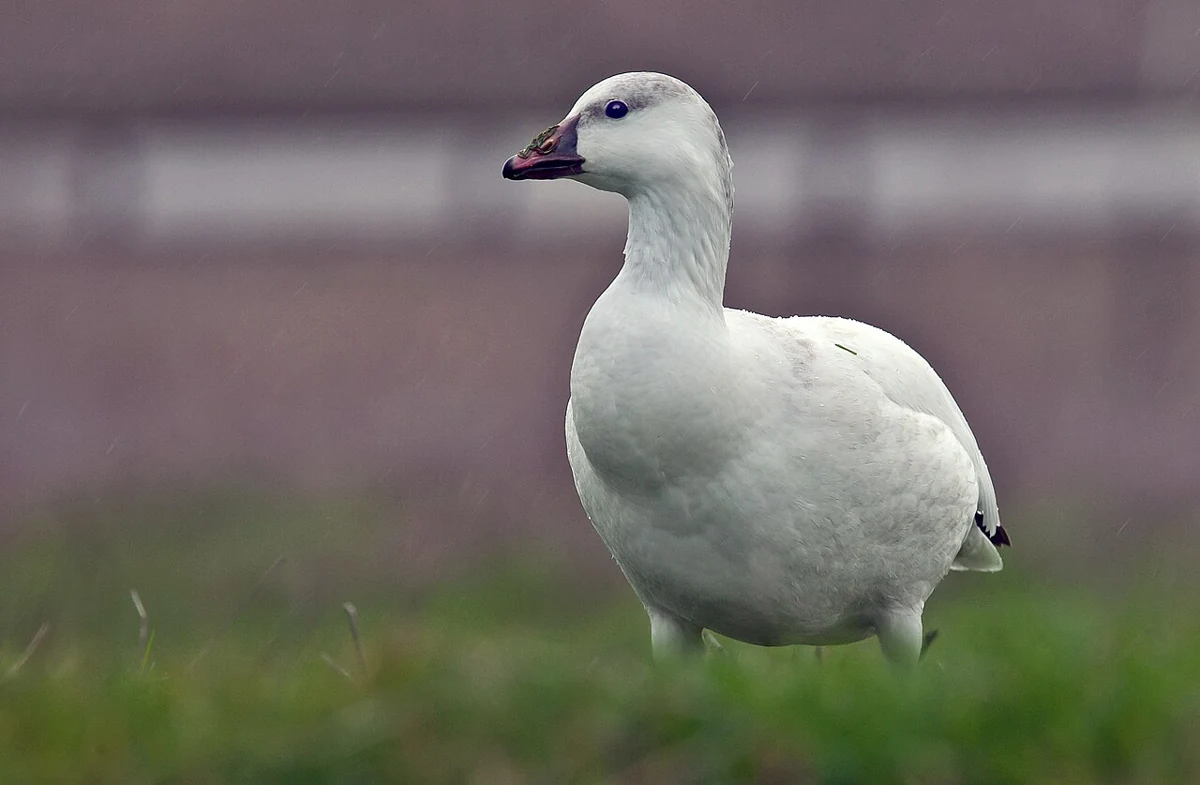
Real reference photograph. Compare several visible features with the full lesson; one photograph does not cover every age, sex, plumage or viewing angle. Resized and WebP encoded without cropping.
Image credit: Mike Baird from Morro Bay, USA · CC BY 2.0 · View image source · CC BY 2.0What you will learn
- Compare the head, bill and neck without depending on plumage alone.
- Practise with adult, juvenile and incomplete views.
- Record a useful uncertain identification and recognise when to stop.
An original SKHunter learning guide
Compare the photographs
Before opening the notes, describe the features you can actually see. Compare the views without treating their displayed sizes as a common scale.
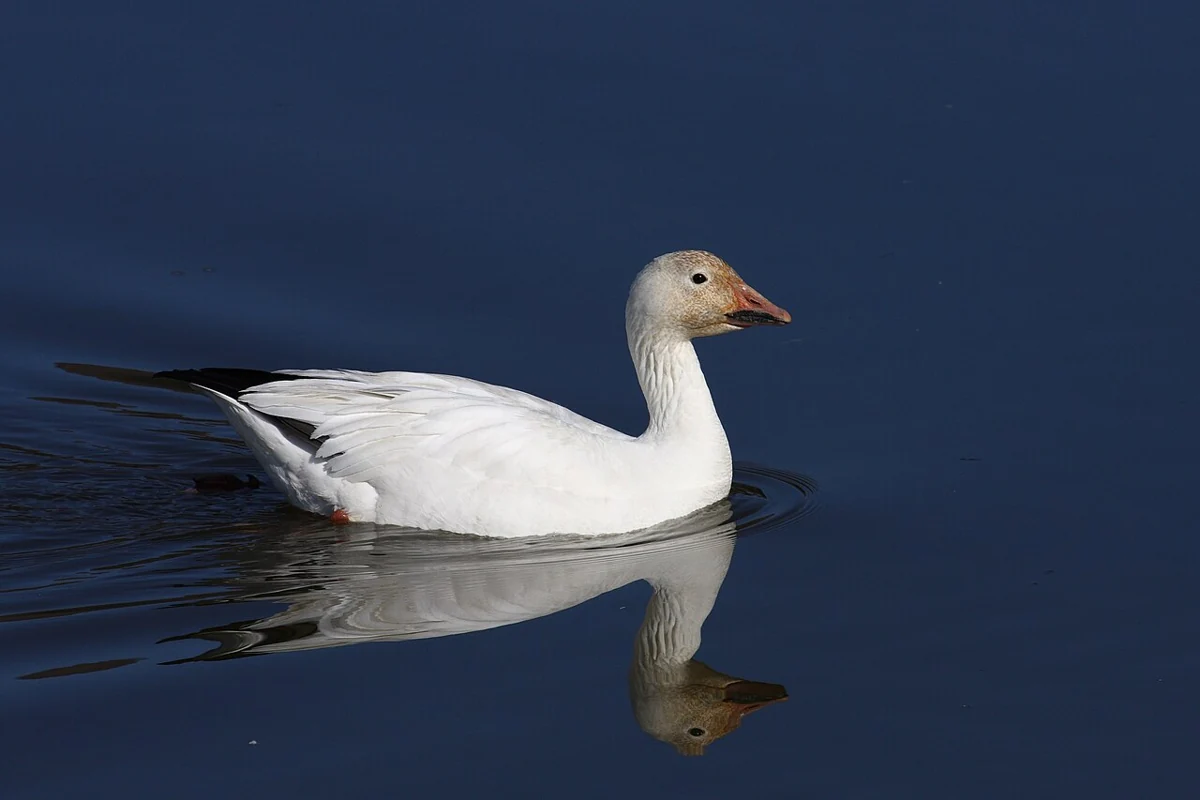
Snow Goose · white morph
Side view on water; the bill and neck remain visible.
Reveal observation notes
What this view lets you examine
- Trace the longer bill outline and its visible dark edge.
- Compare the neck profile with the Ross’s Goose photograph.
Limits of this view
The head is naturally stained. Water hides the legs, and these separate photographs cannot establish relative body size.
Ross’s Goose · white morph
A compact head and short bill seen from a slight angle.
Reveal observation notes
What this view lets you examine
- Follow the short bill’s shape rather than relying on white plumage.
- Observe the head-to-neck proportions visible above the foreground.
Limits of this view
Grass hides the feet; the bird’s angle differs from the Snow Goose view. One dark bill edge is not a universal test.
Build a comparison sheet before going out
Choose a clear side-view reference for each species. On paper draw three empty boxes: head/bill, neck/body and view quality. Label the photographs only after you have written what is visible. Your first task is describing a feature another observer could find, rather than recalling a species name quickly. Keep the photograph’s source and caption with your notes so the exercise can be checked.
Now cover the labels, mix the two photographs and explain your choice aloud. A useful answer is “short bill and compact neck in a clear side view”; “it looks like the one I know” gives you nothing to test. Repeat with a different photograph, not another crop of the same bird.
Read structure before colour
A Snow Goose usually has a longer bill with a conspicuous dark grin patch. Ross’s Goose has a shorter, more triangular bill and a compact head/neck impression. Both light forms can look white with black wingtips, so that colour pattern does not separate them. Relative size is most useful when birds are side by side at similar distance.
Use binoculars from a lawful, stationary observation place. Track one bird for several moments, noting which features appear in profile and which are hidden. Do not compare a foreground bird with a distant bird as if they share a ruler. Make two columns, “seen” and “not seen”, before deciding whether the structure supports a species.
Make room for young birds and colour forms
Snow Goose includes a dark or blue colour form; a dark body does not automatically establish another species. Young Ross’s Goose can show some dark marking along the bill, so “a dark line means Snow” is too simple. Compare the whole head and bill, and use the reference’s age and plumage captions.
Prepare four practice cards: clear adult, young bird, dark form and distant bird. Put only genuinely visible marks on each card. If a card cannot be resolved, keep it in the set as an uncertainty exercise. Do not force every photograph into one of two species simply because the lesson discusses two.
Rehearse the view you actually get
At home, view a reference photograph at normal size, then step back from the screen. Write the features that disappear first. A tiny crop enlarged on a phone may make pixels look like a bill edge that the original never recorded. The exercise is about recognising the limit of the image, not inventing detail through zoom.
During a real observation, record light direction, obstruction and whether the bill was seen side-on. A flock overhead may offer no usable head detail. Black wingtips alone also do not establish that a white bird is either of these geese. Leave unfamiliar white birds unclassified and consult the wider identification reference afterwards.
Use a repeatable decision and debrief
Use this order: find the bird, describe structure, compare two or more visible features, then name it only when the view supports that conclusion. Identification and current hunting eligibility are separate checks. When either is unresolved, the practical decision is to keep observing or finish the attempt; urgency does not improve the evidence.
After the visit, save one good comparison and one unresolved observation. Ask a knowledgeable observer to review the original view and your stated reasons before supplying your answer. Record what extra view would have helped. Your next practice goal should be a particular feature, such as bill shape, rather than merely a higher score.
Practice case: one small bird in a white flock
A white goose seems smaller than nearby birds. Its head is turned away, and the birds stand at different distances.
Put it into practice
- Write down white plumage and apparent size, but mark the bill and neck profile as unseen.
- Wait from your authorised observation position for a useful natural side view.
- Compare structure only if the new view is clear; do not fill in the bill from the flock label.
- Keep “light goose, species uncertain” when the useful view never arrives.
Common mistakes to avoid
Using size as a ruler across the field
Perspective can make a distant Snow Goose look smaller. Compare birds in a similar plane and still check structure.
Treating a grin patch as an on/off test
Age, angle and image quality can obscure or complicate that mark. Compare several features.
Forcing every white bird into this pair
Keep unfamiliar or incomplete views unresolved and widen the reference comparison.
A white bird has black wingtips, but its bill and neck cannot be evaluated. What is the sound conclusion?
- Confirmed Snow Goose.
- Confirmed Ross’s Goose because it looks small.
- The view does not support a species identification.
Show the answer and explanation
Answer: C. The view does not support a species identification.
Shared colour is insufficient. The missing structure remains missing; a confident flock label cannot supply it.
Current checks and official context
How to use the references
The biological references explain visible features and variation. Their photographs and captions can support further practice; U.S. pages do not supply Saskatchewan hunting rules.
Before turning recognition into a hunting plan
Use the current official Saskatchewan material for the actual species, person, place, date and activity. The lesson provides no independent determination of eligibility or an open season.
Turn this lesson into your next outing
Review the date, species, starting template and linked day plan in an editable preparation draft. You choose what to add and save.
Prepare your own trip
Review a preparation draftContinue learning
Ducks identification workshop: Mallard, Northern Pintail and American WigeonTry a practical situation
A smaller goose, or a more distant goose?Opening a draft does not create a saved checklist. A checked item records your own review, not permission or an open season.
Scenario practice
Put your field decisions into practice.
Try 24 situations across identification, access, field adjustments and harvest care. Compare your choice with the explanation, then revisit the relevant lesson.
Original sources
- Cornell Lab of Ornithology · Snow Goose identification
- Cornell Lab of Ornithology · Ross’s Goose identification
- North Dakota Game and Fish · Light goose identification (biology reference)
- Missouri Department of Conservation · Waterfowl identification (biology reference)
- ECCC · Current Saskatchewan migratory-bird summary
Use this as a planning guide. Check current official requirements and site conditions before travelling.
Help improve this guide
Tell the editor about something on this public page that needs attention.